

55+ Team Building Activities That Build Teamwork and Bring Your Team Together in 2026
Every team, no matter how long it’s been together, benefits from time spent outside the usual meetings and deadlines. Team building activities give coworkers a reason to talk, laugh, and solve small problems together, which builds the kind of trust that carries back into everyday work long after the activity ends.
Table of Contents
ToggleThis guide rounds up over 65 tested games and exercises, organized by format so you can find the right fit fast. Whether you’re planning a five minute warm up or a full afternoon retreat, you’ll find icebreakers, problem solving challenges, virtual options, and a few genuinely unique picks in the sections below.
What Are Team Building Activities and Games?
These sessions are structured group exercises designed to strengthen how a team communicates, trusts, and works together. Some are quick icebreakers meant for the start of a meeting, while others are longer team building games built around problem solving, creativity, or physical cooperation. The format changes, but the underlying goal stays the same.
At their core, these are activities that build teamwork by giving people shared, low stakes experiences outside their normal job duties. A well chosen pick, whether that’s icebreaker games for work or something bigger like workplace team building exercises, can improve morale and help new hires feel like part of the group faster than meetings alone ever could.
How to Choose the Right Team Building Activity for Your Team
Picking the right activity comes down to a few practical factors rather than guesswork. Team booster activities that work beautifully for a group of six can fall flat with sixty people, and a game built for a conference room won’t translate to a fully remote team. Walk through these four questions before you commit to a format.
-
Group size:
Small teams can handle deeper, more personal exercises like storytelling or two truths and a lie. Team building activities for large groups need something built to scale instead, like scavenger hunts or a trivia night.
-
Goals and skills:
Decide what you actually want to improve first, communication, creativity, or trust. A trivia night builds different muscles than a blindfolded rope challenge does.
-
In-person vs. remote:
Remote teams need activities that translate to a screen, like virtual trivia or a photo caption contest. In-person teams can take on physical or outdoor challenges instead.
-
Time and setting:
A packed meeting schedule calls for a five minute icebreaker, not an hour long build challenge. Simple office team building activities work best when saved for retreats or dedicated team days instead.
What Frogbridge Offers for Team Building Days
Reading about good activities is one thing that actually running them somewhere your whole team can spread out and breathe is another. Frogbridge Events is an 86-acre resort in Millstone Township, New Jersey, and our team has coordinated team building days and corporate retreats for numerous Fortune 500 companies. Every package below is included on-site, without needing outside vendors, extra rentals, or a separate facilitator to run it.
| Category | What’s Included |
| Water-Based Challenges | Kayak relays, pedal boat races, and bumper boat competitions on our private lake |
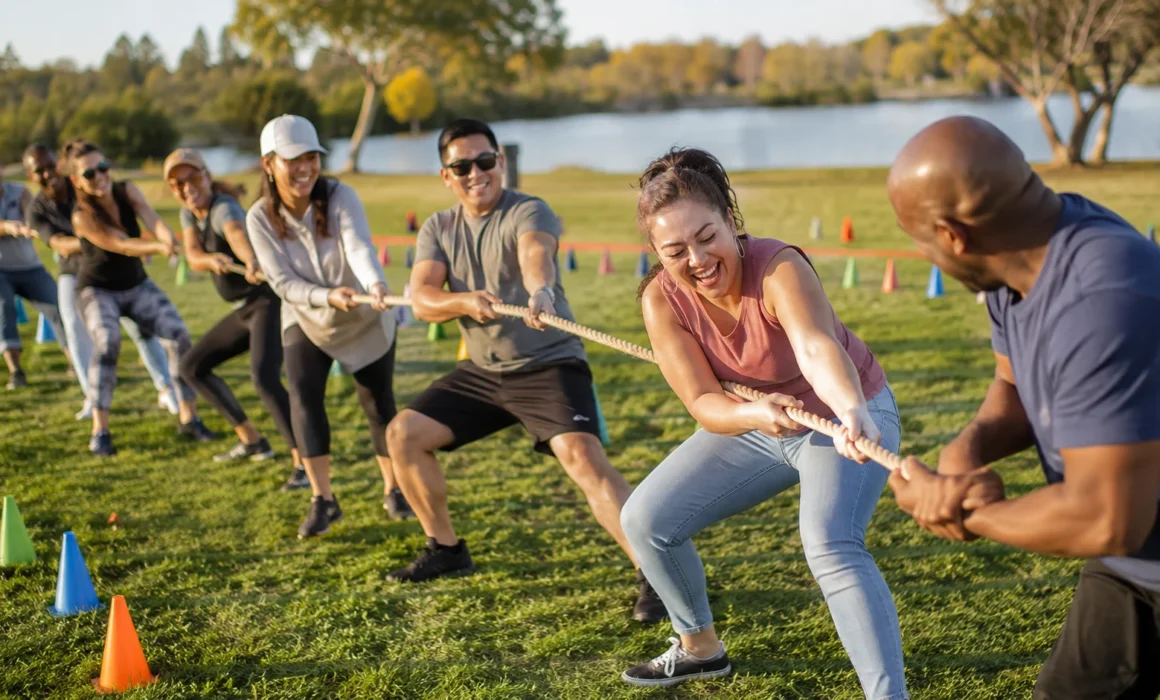
| Land-Based Games & Relays | Tug of war, water balloon toss, treasure hunt, and relay races as part of our Team Spirit packages |
| Sports & Fields | Soccer fields, tennis courts, basketball courts, bocce and horseshoes, beach volleyball, mini golf, and a driving range |
| Premium Add-Ons | Go-kart track, outdoor laser tag, extreme ziplining, and spin zone bumper cars (available for an additional fee) |
| Entertainment & Staffing | DJ, a Team Spirit Leader, professional staff, custom signage, and medals for winning teams |
| Catering | Continuous catering under a private covered pavilion from our on-site chef, William Towle, a Johnson & Wales University-trained culinarian, off-the-grill staples, specialty stations, and upgrade menus like Clam Bakes and Smokehouse BBQ, with gluten-free, vegetarian, vegan, and halal options available |
Our standard team building package runs five hours of non-stop music and activities with exclusive access to the property, and everything above is fully customizable to your group’s size and goals. Everything past this table is general inspiration pulled from research on great team activities everywhere. You’re welcome to run any of these yourself with your own team, or bring them up when you call. Our event planner can often work several of these ideas directly into an actual day booked on our grounds, whether that’s a team building day, a full corporate retreat, or a school or company picnic.
Team Building Icebreaker Games
Team building icebreaker games are the fastest way to warm up a room before the real agenda starts. They work just as well for introducing new hires as they do for teams who’ve worked together for years. Use these icebreaker games for team meetings whenever you need a quick, low pressure way to get everyone talking.
1. Two Truths and a Lie
- Team Size: 3+ people
- Time: 2–3 minutes per person
Purpose
Breaks the ice with new or unfamiliar teammates. Turns simple facts into natural conversation starters.
How to Play
Ask everyone to think of two true facts about themselves and one convincing lie. Each person shares all three statements while the group tries to guess which one isn’t true. The more surprising the truths and the more believable the lie, the more fun the round becomes for everyone involved.
Why This Exercise Is Great
This game works best with teams who don’t know each other well yet. The details people share often become natural follow-up questions later, giving coworkers an easy way to keep the conversation going after the game ends.
2. Penny for Your Thoughts
- Team Size: 5+ people
- Time: 2–3 minutes per person
Purpose
Gives every teammate a low pressure way to share a personal story. Works well as a warm opener for any meeting.
How to Play
Fill a jar with coins minted no earlier than your youngest teammate’s birth year. Have each person draw one coin and share a memory, milestone, or story from that specific year printed on it, whether that’s learning to ride a bike, moving to a new city, or landing a first job.
Why This Exercise Is Great
This puts a fun spin on a simple icebreaker, giving every teammate a chance to share something personal. Run multiple rounds if stories are short, or let people elaborate for a deeper look into each other’s lives.
3. Mood Pictures
- Team Size: 5+ people
- Time: 2–3 minutes per person
Purpose
Helps a facilitator read the room before a meeting starts. A creative, low stakes way to talk about feelings.
How to Play
Lay out a variety of images, magazine cutouts, postcards, or printed photos showing landscapes, people, and shapes in different colors. Ask each teammate to pick whichever image matches their current mood or their expectations for the meeting, then explain to the group why they chose it and what it says about how they’re feeling.
Why This Exercise Is Great
A picture is worth a thousand words, so this makes talking about feelings easier for people who find that hard to put into sentences. It’s a great way to open a workshop with something visual and unexpected.
4. One Word Exercise
- Team Size: 3+ people
- Time: 5–10 minutes
Purpose
Collects honest opinions before a meeting begins. Helps facilitators gauge the room in seconds.
How to Play
Pick a phrase tied to the meeting topic and ask everyone to write down the first word that comes to mind. Gather the words on a whiteboard or shared doc so the whole group can see them at once. If the words trend negative, it’s worth pausing to ask why.
Why This Exercise Is Great
This stays well within most people’s comfort zone while still surfacing real concerns. Reading the room before diving into a topic makes the rest of the meeting more useful for everyone in it.
5. Back-to-Back Drawing
- Team Size: 4+ people
- Time: 5–10 minutes
Purpose
Sharpens listening skills through a fun communication challenge. Works well for pairs who don’t usually talk much.
How to Play
Split the team into pairs sitting back to back. Show one partner a simple image, like a house or a flower, and have them describe only its shapes, sizes, and textures so the other can draw it, without ever naming the object itself. Compare drawings to the original once time is up.
Why This Exercise Is Great
This is a fun, low stakes way to sharpen listening skills. It also gives teammates a reason to think creatively about how to describe something clearly without relying on the obvious word for it.
6. Birthday Line Up
- Team Size: 8+ people
- Time: 10–15 minutes
Purpose
Builds nonverbal communication and cooperation. A fast way to get a whole team moving together.
How to Play
Ask the entire team to line up in order of their birthdays, month and day only, without speaking to each other at all. Gestures, sign language, and nudges are fair game. Add a time limit if you want to raise both the pressure and the laughter in the room a bit.
Why This Exercise Is Great
Besides learning everyone’s birthday, which comes in handy later as a conversation starter, this exercise pushes the team to work toward a shared goal using only nonverbal communication and patience.
7. Charades
- Team Size: 8–10 people
- Time: 10–25 minutes
Purpose
A classic way to break up a mentally heavy day. Gets everyone laughing without needing any prep.
How to Play
Split into groups of four or five. Show the first player an object, like a stapler or a keyboard, and have them act out how to use it without speaking or showing the object. Their team gets a set time to shout out the answer before the turn passes on.
Why This Exercise Is Great
This classic game is a nice way to break up a mentally taxing day. It gives the team a creative, work free exercise that gets everyone laughing within the first couple of rounds.
8. Common Thread
- Team Size: 10+ people
- Time: 30 minutes
Purpose
Surfaces surprising commonalities between coworkers. Especially useful for teams that feel a bit divided.
How to Play
Divide the team into groups of three to five and ask each group to find things every member has in common, favorite shows, ice cream flavors, hobbies. Push them to go past the obvious answers. If time allows, bring the whole team back together so each group can share what they found.
Why This Exercise Is Great
Finding real commonalities that people wouldn’t normally discover at work can help reconnect a team that’s started to feel a little divided or distant from each other lately, especially after a stretch of remote or heads down work.
Quick Get To Know You Team Building Activities
Quick get to know you games are built for teams still learning each other’s names, or established teams who want a fresh way to reconnect. These get to know you games for work need almost no setup, which makes them an easy addition to any meeting, onboarding session, or team offsite agenda.
9. 3 Question Mingle
- Team Size: 2–40 people
- Time: 30–60 minutes
Purpose
Combines structure with self direction so people ask what they genuinely want to know. Great for early stage teams.
How to Play
Each person writes three questions on sticky notes, then finds a partner for a one minute meeting. They each ask the other one question, trade sticky notes, and move on to a new partner. Keep the mingling going until most of the room has connected with someone new at least once.
Why This Exercise Is Great
This gets an entire team moving and talking while letting people ask the questions they actually want answered, rather than ones a facilitator picked for them ahead of time for the session.
10. Best and Worst
- Team Size: 5–10 people
- Time: 10–15 minutes
Purpose
Ignites conversation by letting people share both highs and lows. Works well for smaller, closer teams.
How to Play
Ask each participant to write one question about the best and worst version of something, like a favorite recipe or a worst injury ever sustained. Collect the questions in a hat, draw pairs at random, and invite the group to share their answers and the stories behind them out loud.
Why This Exercise Is Great
Pulling questions from a hat keeps things playful and unpredictable, and the stories that come out often reveal sides of teammates that don’t usually surface during a normal workday together.
11. Group Order
- Team Size: 5+ people
- Time: 5–10 minutes
Purpose
Gets a room talking fast with almost no setup. A reliable energizer for the start of any session.
How to Play
Ask the group to line themselves up based on a simple criterion, distance from home to the office, birth month, or number of countries visited so far in life. No talking is required to start, but people quickly begin comparing notes to figure out exactly where they belong in the line.
Why This Exercise Is Great
This needs nothing more than a room and a group willing to move around, and it reliably gets people comparing notes and talking with each other within the first minute or two.
12. Happiness Exercise
- Team Size: 4–30 people
- Time: 10–20 minutes
Purpose
Builds a positive atmosphere by focusing on joy rather than problems. Useful after a stressful stretch.
How to Play
Ask each teammate to share one thing that genuinely makes them happy, a hobby, a small daily ritual, or a favorite memory from earlier in life. Go around the group so everyone gets a turn, and let people ask follow up questions if a particular story catches their interest along the way.
Why This Exercise Is Great
Sharing joyful, low stakes stories helps defuse tension after a difficult stretch and reminds a team that there’s more to each other than the current workload sitting in front of them.
13. Name Juggling
- Team Size: 5+ people
- Time: 1–15 minutes
Purpose
Reinforces name recall through movement and light strategy. Ideal for brand new teams.
How to Play
Stand in a circle and have everyone introduce themselves by name. Introduce a ball, and have the holder say another person’s name before tossing it to them. That person thanks the sender by name, then passes it on. Once it’s smooth, add a second or third ball to raise the challenge.
Why This Exercise Is Great
This turns the usually awkward process of learning new names into something active and a little competitive, which makes the names stick far better than a simple round of introductions.
14. Open Fist
- Team Size: 3+ people
- Time: 5–10 minutes
Purpose
Finds common ground quickly by limiting how much people can share. Easy to slot into any agenda.
How to Play
Ask each person to hold up one open hand. Going around the group, teammates share one fact about themselves at a time, and anyone who shares that same fact folds down a finger. The goal is to find enough shared facts to close a full fist before time runs out.
Why This Exercise Is Great
Limiting the exercise to five facts keeps it quick and focused, and finding real overlap with coworkers tends to make a team feel more cohesive almost immediately after just one round.
Fun Team Building Activities
Sometimes the goal isn’t deep reflection, it’s just getting a team laughing together. These fun activities for team building are built to loosen up a room fast. Use these fun games to build teamwork whenever the day needs a lighter touch, and lean on these fun team building exercises anytime a meeting runs long or energy starts to dip.
15. Bang
- Team Size: 10–40 people
- Time: 5–30 minutes
Purpose
A fast, silly game that sharpens reactions and helps with name recall. Great opener for any size group.
How to Play
Stand in a circle with one person acting as sheriff in the middle. The sheriff spins and points at a player, shouting “bang.” That player crouches instantly while the two people beside them quickly point at each other and shout each other’s names as fast as they can. Whoever reacts too slowly is out.
Why This Exercise Is Great
The quick reactions and constant name calling make this a great early game for brand new teams, and it reliably gets a room laughing within the first couple of rounds.
16. Build-a-Shake
- Team Size: 4+ people
- Time: 5–10 minutes
Purpose
Brings out playful creativity through a shared, silly ritual. Works well for teams looking to bond quickly.
How to Play
Pair people up and ask each pair to invent a short secret handshake together. After a few minutes, have pairs rotate and teach their handshake to a new partner, building on what they learn along the way until most of the group is sharing some version of the same growing routine.
Why This Exercise Is Great
This taps into the same creativity most people had as kids, and teaching your handshake to a new partner each round is a genuinely easy way to build closeness fast.
17. Count Up
- Team Size: 10–40 people
- Time:5–30 minutes
Purpose
Demonstrates the power of quiet, coordinated teamwork. Simple to run with no materials needed.
How to Play
As a group, try to count out loud from one to twenty with eyes closed, no assigned order, and no two people speaking a number at the same time. If two people talk over each other, the whole group starts over from one. Keep trying until you reach twenty cleanly.
Why This Exercise Is Great
This looks simple but takes real focus and awareness, and it’s a surprisingly effective way to show any team exactly what calm, coordinated listening actually feels like in practice together.
18. Follow the Leader
- Team Size: 2+ people
- Time: 5–20 minutes
Purpose
Builds group cohesion through observation and a bit of silliness. Works equally well online or in person.
How to Play
Designate one person as leader and have everyone else copy their movements exactly as closely as they possibly can. On video calls, switch to gallery view so everyone can see and follow along easily. Rotate the leader every minute or two so different people get a turn setting the pace.
Why This Exercise Is Great
Being a little silly together tends to produce genuine laughter fast, and rotating the leader role means everyone gets a turn setting the tone for the group at some point.
19. Portrait Gallery
- Team Size: 2–40 people
- Time: 30–60 minutes
Purpose
Turns a simple drawing exercise into a colorful, collaborative keepsake. Great icebreaker for larger groups.
How to Play
Split the group into two teams. One team draws portraits of the other, but every ten to fifteen seconds, the drawing gets passed to a new artist to continue where the last one left off. By the end, every person on the other team has a genuinely collaborative portrait made by several teammates.
Why This Exercise Is Great
The resulting gallery of portraits is colorful and a little chaotic, and passing drawings between artists breaks the ice fast, even in a group that’s never worked together before this.
20. Snowball
- Team Size: 8–50 people
- Time: 20–40 minutes
Purpose
Combines movement with anonymous sharing for a playful energy boost. Good fit for larger, energetic groups.
How to Play
Ask a question relevant to the group and have everyone write an answer on a sheet of paper. Crumple the papers into snowballs and have a real snowball fight in the middle of the room together. After a few minutes, everyone grabs one snowball and tracks down whoever wrote it.
Why This Exercise Is Great
The physical snowball fight gets people out of their seats fast, and hunting down the person who wrote each answer naturally sparks conversations that wouldn’t happen otherwise during a normal day.
21. Rock, Paper, Scissors (Tournament)
- Team Size: 4+ people
- Time: 5–10 minutes
Purpose
A quick, loud energizer that builds excitement before a bigger activity. Needs zero setup or materials.
How to Play
Pair everyone off for a game of rock, paper, scissors, and have losers become fans of the winner as the bracket advances round by round. Keep pairing off winners until only two players remain for a final showdown, cheered on loudly by the rest of the group who lost earlier rounds.
Why This Exercise Is Great
Watching a crowd of former opponents cheer on the finalists creates real, shared excitement fast, and it’s a fun way to warm a group up before something more involved starts.
Indoor Team Building Activities
Indoor team building activities are the easiest option when the weather doesn’t cooperate or your office is the only space available. Most of these indoor team building games fit inside a conference room or open hallway, and several scale up nicely if you want to include a larger group without leaving the building.
22. Perfect Square
- Team Size: 4–12 people
- Time: 15–30 minutes
Purpose
A blindfolded trust and communication exercise. Reveals how well a small team listens under pressure.
How to Play
Split into groups of four to six standing in a tight circle, blindfolded, holding a length of rope. Without looking, the group has to pass the rope around and arrange it into a perfect square using only verbal instructions. Lay the rope down and remove blindfolds to check the result.
Why This Exercise Is Great
Because nobody can see what they’re doing, this becomes a genuine test of clear verbal communication, and it’s often hilarious to see how imperfect the final squares turn out to be.
23. Memory Wall
- Team Size:5+ people
- Time: 15–30 minutes
Purpose
Ends a long day or workshop on a warm, shared note. Simple to run with just sticky notes.
How to Play
Write a few work related themes on a whiteboard, like first day at work or favorite team celebration. Hand out sticky notes and ask everyone to jot down a favorite memory tied to one theme, then invite people to share and post their notes on the wall as they go.
Why This Exercise Is Great
Taking a walk down memory lane like this is a nice way to close out a long week or multi day workshop, leaving the team with something to smile about.
24. Paper Plane
- Team Size: 6–12 people
- Time: 20–30 minutes
Purpose
Combines quick design thinking with a fun physical competition. Great for a tight timeline.
How to Play
Split into pairs or small groups and hand out card stock. Give each team ten to fifteen minutes to design the best long distance paper plane they can, plus a name for their airline. Line up in a hallway or outside afterward and see whose plane flies the farthest overall.
Why This Exercise Is Great
This forces fast collaboration under a tight timeline, which makes it a solid way to practice delegation and time management without anyone in the group feeling any real added pressure.
25. Build a Tower
- Team Size: 8–16 people
- Time: 20–30 minutes
Purpose
A classic engineering challenge that rewards fast prototyping. Works well for larger teams split into small groups.
How to Play
Divide into groups of four or five and give each team twenty sticks of uncooked spaghetti, tape, string, and one marshmallow to work with. Challenge every team to build the tallest freestanding tower that can support the marshmallow on top, all within a strict twenty minute time limit set in advance.
Why This Exercise Is Great
Watching towers succeed or collapse under a countdown clock says a lot about how well a team prototypes, communicates, and adjusts a plan once the first attempt fails badly halfway through.
26. Flip It Over
- Team Size: 6–8 people
- Time: 20–30 minutes
Purpose
A funny, physical test of cooperation. Needs only a blanket or sheet to run.
How to Play
Lay a blanket or sheet on the floor and have the whole team stand on it. The challenge is to flip the fabric completely over without anyone stepping off it or touching the floor around it. Make it harder by shrinking the sheet or adding more people to the group.
Why This Exercise Is Great
This oddly difficult task demands real cooperation and a good sense of humor, and it’s a fast, physical way to see how well a team improvises together under a little pressure.
27. Sneak a Peek
- Team Size: 4–20 people
- Time: 30 minutes
Purpose
Tests communication under a strict time crunch. A fun twist on a basic building challenge.
How to Play
Build a small Lego structure ahead of time and hide it in another room. Split into groups with their own Lego pieces, and let one rotating scout per team sneak a fifteen second look at the original before running back to describe it. First team to match the structure wins.
Why This Exercise Is Great
Since only one scout at a time gets to look, teammates end up describing different details, which makes clear, specific communication the real skill being tested throughout this whole exercise.
28. Pyramids
- Team Size: 8–24 people
- Time: 30 minutes
Purpose
A relay style race that rewards teamwork under time pressure. Fun as a mid-day energy break.
How to Play
Line teams up with space between each player and give the first person in line ten paper cups. That player builds a four cup pyramid, then the next player helps carry it to the next station without letting it collapse, toppling and rebuilding it there before handing off to the next runner.
Why This Exercise Is Great
The constant rebuilding and careful carrying makes this a fun, fast paced way to practice teamwork and communication during any mid-day break in a longer event or a full workshop day.
29. Team Flag
- Team Size: 6–20 people
- Time: 30–45 minutes
Purpose
Surfaces shared values through a creative design task. Great for teams defining their identity.
How to Play
Split into small groups and hand out paper and pens. Each group designs an emblem or flag that represents their team’s identity, then presents it to everyone else, explaining the choices behind the design and exactly how the group landed on their shared values along the way through open discussion.
Why This Exercise Is Great
Designing and presenting a shared symbol pushes a group to actually talk through their values together, which makes this more meaningful than a typical drawing exercise ever could hope to be.
Outdoor Teamwork Games
Outdoor team building activities take advantage of fresh air and open space in a way no conference room ever could. For more inspiration built around a picnic style event, our guides to Top 8 Company Picnic Games and the Complete List of 55+ Corporate Picnic Themes, Games and Activities cover plenty more outdoor team building games worth adding.
30. The Minefield
- Team Size: 4–10 people
- Time: 15–30 minutes
Purpose
A trust exercise built entirely on verbal communication. Works best outdoors or in a large open room.
How to Play
Scatter cones, balls, and bottles across an open space to create a minefield. Pair up, blindfold one partner, and have the other guide them across using only spoken directions from a safe distance. The blindfolded partner can’t talk and is eliminated if they step on an object or stop moving.
Why This Exercise Is Great
This is as much a trust exercise as a listening one, since the blindfolded partner has to rely completely on clear, calm directions to make it across the field safely.
31. Earth-Ball
- Team Size: 5–20 people
- Time: 15–45 minutes
Purpose
A high energy game that gets everyone moving at once. No skill required, just teamwork and quick reflexes.
How to Play
Stand in a circle with a balloon, beach ball, or volleyball and try to keep it in the air as long as possible. The only rule is that no one can touch it twice in a row. Track your best streak and try to beat it as a team each new round.
Why This Exercise Is Great
The bigger the group, the more fun this gets, and trying to beat your own record naturally pushes the whole team to communicate and strategize on the fly together as one.
32. Scavenger Hunt
- Team Size: 8+ people
- Time: 45–90 minutes
Purpose
A flexible outdoor challenge that scales to almost any group size. Easy to tailor to your company.
How to Play
Build a list of photos to take or items to collect around the property, a company logo shot, a specific colored leaf, or a signature from a manager. Group people who don’t know each other well, and offer a small prize for the fastest or most creative team of the day.
Why This Exercise Is Great
Tailoring the list with company specific inside jokes or trivia gives the hunt personality, and grouping unfamiliar teammates together gives quieter people a natural reason to bond quickly and easily.
33. Egg Drop
- Team Size: 4–12 people
- Time: 60–90 minutes
Purpose
A hands on engineering challenge with a dramatic finale. A memorable way to close out a longer event.
How to Play
Give small teams a raw egg plus tape, straws, rubber bands, and newspaper, then set a sixty minute limit to build a structure that protects the egg from a second or third story drop below. Gather everyone for the grand finale to see whose careful design actually survives the fall.
Why This Exercise Is Great
Designing under a countdown clock forces real collaboration fast, and the dramatic drop at the end gives the whole team a shared, memorable moment to close the entire day on together.
34. Team Outing
- Team Size: Any
- Time: Any
Purpose
A flexible, low pressure way to bond outside the office. Works for any budget or group size.
How to Play
Plan a shared experience away from the usual work environment, a cooking class, a museum trip, a bowling night, or a casual 5K run together as a group. The specific activity matters less than the setting, somewhere new where casual conversation flows more naturally than it does across a conference table.
Why This Exercise Is Great
Taking the team somewhere new lowers the usual professional distance, and casual conversation tends to flow far more easily at a restaurant or a park than it ever does at a desk.
35. Volunteer as a Team
- Team Size: 5+ people
- Time: Any
Purpose
Builds bonds through shared purpose rather than competition. Doubles as a genuine benefit to the community.
How to Play
Organize a team volunteer event during regular work hours, a charity drive, a local park cleanup, or packing meals for a food bank for the community. Scheduling it as paid time signals that this is a real perk rather than an extra obligation stacked on top of everyone’s already busy workload.
Why This Exercise Is Great
Sharing the feeling that comes from doing good together tends to bond a team on a deeper, more lasting level than most competitive games out there ever manage to do.
Physical Team Building Activities
Physical team building activities ask a group to solve a problem with their bodies, not just their words. These team building physical activities tend to produce the fastest, most visible results because a team either figures out the coordination together or the whole exercise falls apart in front of everyone watching.
36. Blind Square – Rope Game
- Team Size: 4–20 people
- Time: 40–45 minutes
Purpose
Tests planning and communication under a blindfold. A reliable favorite for facilitators.
How to Play
Tie a length of rope into a circle and give the group a few minutes to plan how they’ll shape it into a perfect square. Blindfold everyone, then give the team ten minutes to form that square using only the plan they made together and verbal coordination in the dark.
Why This Exercise Is Great
This delivers reliable results with almost any group, since it clearly reveals whether a team over-plans, under-communicates, or quietly lets just one single person take over the whole task alone.
37. Crocodile River
- Team Size: 10–40 people
- Time: 60–120 minutes
Purpose
A large scale physical challenge built on mutual support. Best suited to bigger teams outdoors.
How to Play
Mark out a wide stretch of open space as the river and challenge the group to get everyone across to the other side. The only way across is by physically supporting one another, so the team has to figure out a strategy together before anyone can safely make the crossing.
Why This Exercise Is Great
Changing the setting to something physically demanding stretches a team’s problem solving muscles while also putting their leadership and patience under a bit of healthy shared pressure together for once.
38. Helium Stick
- Team Size: 5+ people
- Time: 5+ minutes
Purpose
A famously tricky exercise that looks simple on paper. Needs zero setup or materials to run.
How to Play
Have the group hold out their index fingers and balance a long, light pole across them. The challenge is to lower the pole all the way to the ground while every finger stays in contact with it the entire time, which is far harder than it sounds at first try.
Why This Exercise Is Great
The pole tends to rise instead of lower at first, which makes for an instant, honest lesson in how easily a group’s instincts can work against its own stated goal.
39. Lego Challenge
- Team Size: 10–40 people
- Time: 60–120 minutes
Purpose
Explores how hidden assumptions shape group dynamics. A creative, hands on building exercise.
How to Play
Give the team a shared pile of Lego and a structure to build together, but hand each person a private, secret assignment that shapes how they’re allowed to contribute to it. Watch how the group negotiates around these hidden constraints while still trying to finish a cohesive final structure on time.
Why This Exercise Is Great
The hidden assignments quietly surface leadership dynamics, conflict, and genuine cooperation that a normal building exercise usually keeps completely invisible until the very end of the entire shared session together.
40. Marshmallow Challenge
- Team Size: 6–100 people
- Time: 45–60 minutes
Purpose
A time pressured design sprint with a satisfying visual result. Works for teams of nearly any size.
How to Play
In just eighteen minutes, small teams build the tallest freestanding structure they can using twenty sticks of spaghetti, some tape, string, and exactly one marshmallow, which has to sit right on top when time runs out. Debrief afterward by asking who took the lead and how roles shifted along the way.
Why This Exercise Is Great
The built in debrief about roles and leadership is what separates this from a simple building game, turning eighteen chaotic minutes into a genuinely useful discussion for the whole team.
41. Spider Web
- Team Size: 6–20 people
- Time: 15–30 minutes
Purpose
A trust building challenge with a physical puzzle at its center. Best run outdoors with some space.
How to Play
Build a web of string or rope between two poles, with several gaps of different sizes woven all through it. Challenge the group to get everyone through a gap safely, without anyone touching the string, and without reusing the same gap twice for more than one person in the group.
Why This Exercise Is Great
The constraint of not reusing gaps forces real problem solving and physical trust between teammates, since bigger people often need real, hands on help fitting through the smaller openings safely enough.
Team Building Problem Solving Activities
Teamwork problem solving activities push a group past their usual routines and into genuine collaborative thinking together. These team building problem solving activities work well whenever you want to practice decision making under a deadline, without the real stakes of an actual work project hanging over the exercise the whole time.
42. Your First Idea
- Team Size: 5–12 people
- Time: 10–20 minutes
Purpose
Uncovers overlooked solutions by skipping overthinking. Works with a real problem or a fictional one.
How to Play
Present the group with a real or fictional problem and ask everyone to write down the very first idea that comes to mind. Compile the list and review it together. As a fun twist, ask for everyone’s worst idea instead and see how many turn out to be workable after all.
Why This Exercise Is Great
We often overthink problems until the obvious answer gets buried, so writing down that first instinct can uncover a genuinely useful fix that was hiding in plain sight the whole time.
43. Back of the Napkin
- Team Size: 6–24 people
- Time: 15–20 minutes
Purpose
Forces fast, creative thinking under a tight constraint. A quick way to spark new ideas.
How to Play
Split into groups of two to four and hand each team an open ended problem, real, fictional, or environmental in nature. Give them a single napkin and pen to sketch or write out their solution before pitching it back to the rest of the room in a quick, informal presentation.
Why This Exercise Is Great
Some of history’s best ideas have reportedly started on napkins, and this exercise recreates that same scrappy creativity while still asking the team to collaborate on a genuinely real answer.
44. Spectrum Mapping
- Team Size: 5–15 people
- Time: 30–60 minutes
Purpose
Visualizes how diverse a team’s opinions really are. Useful before a big decision.
How to Play
Write a few discussion topics on a whiteboard and hand out sticky notes. Ask everyone to write their opinion and post it under the relevant topic, then work together to arrange similar ideas toward one side and outlier opinions toward the other, forming a visible spectrum of thought for everyone.
Why This Exercise Is Great
Seeing the full spread of opinions laid out visually helps a team notice that unpopular ideas aren’t automatically wrong, which often unlocks a genuinely useful new perspective for the whole group.
45. What Would “X” Do?
- Team Size: 5–10 people
- Time: 45–60 minutes
Purpose
Breaks people out of their own head by borrowing someone else’s perspective. Fun and a little theatrical.
How to Play
Present the group with a real problem and ask each person to pick a leader or public figure they admire. Challenge everyone to solve the problem as if they were that person, channeling their mindset and decision making style, with bonus points for really committing to the character the whole time.
Why This Exercise Is Great
Stepping into someone else’s mindset often unlocks solutions a person would never have reached while stuck inside their own usual, everyday way of thinking about a stubborn problem entirely alone at their desk.
46. Team Pursuit
- Team Size: 6–24 people
- Time: 1–3 hours
Purpose
A multi challenge competition that gives every skill set a chance to shine. Great for team days.
How to Play
Split into small competing groups and run them through a series of challenges: logic puzzles, physical skill tests, and open ended creative tasks to solve. Buy a ready made team pursuit kit online, or build your own series of challenges tailored specifically to your group’s interests and shared inside jokes.
Why This Exercise Is Great
Because the challenges cover logic, skill, and creativity, everyone gets at least one real moment to shine, which shows teammates sides of each other they genuinely hadn’t really seen before now.
47. Code Break
- Team Size: 8–24 people
- Time: 1–3 hours
Purpose
A competitive brain teaser that works indoors or out. Scales down easily into smaller groups.
How to Play
Run a series of coded clues and puzzles that teams have to crack in sequence to progress through the course from start to finish. Self hosted kits and fully guided, professionally run versions are both available if you’d rather not build the entire puzzle trail from scratch on your own.
Why This Exercise Is Great
Breaking a large group into smaller competing teams keeps the challenge manageable while still creating a genuinely competitive, creative thinking environment for absolutely everyone involved in the whole day’s event.
48. Escape Room
- Team Size: 3+ people
- Time: 2–3 hours
Purpose
A ready made problem solving adventure with no setup required. Reveals real strengths under pressure.
How to Play
Book a local escape room and pick a theme the whole group will enjoy, whether that’s history, horror, or science fiction. If you have the time and creativity, you can even build a simple version of your own using a locked room, a handful of clues, and a countdown timer.
Why This Exercise Is Great
Solving the mystery together tends to reveal a team’s real strengths and weaknesses fast, while building the kind of shared memory that sticks with a group long after the event ends.
Board Games & Retreat Activities
Board games for team building are an easy way to spark collaboration without any prep, equipment rental, or facilitator required. If you’re planning a retreat, our full breakdown of 3 Top Team Building Board Games for a Company Retreat goes deeper on which team building board games work best for a longer, more relaxed event.
49. Codenames
- Team Size: 4–8 people
- Time: 15–30 minutes
Purpose
A word association game that rewards creative, careful thinking. Great for smaller, mixed groups.
How to Play
Split into two teams, each with a spymaster who gives one word clues pointing to several cards their own team needs to guess correctly and quickly. The rest of each team debates and guesses based on the clue, racing to identify all their words before the other team finishes first overall.
Why This Exercise Is Great
Giving a good clue means thinking the way your whole team thinks, which makes this a surprisingly sharp lesson in perspective taking disguised as a genuinely fun party game for everyone.
50. Pandemic (Cooperative Board Game)
- Team Size: 2–4 people per table
- Time: 45–60 minutes
Purpose
A fully cooperative game where the whole team wins or loses together. Builds shared strategy fast.
How to Play
Everyone plays on the same side, working together to stop four diseases from spreading across a shared game board before precious time runs out completely. Each player has a different role with unique abilities, so the group has to coordinate closely and plan several moves ahead together as one single unit.
Why This Exercise Is Great
Because there’s no winner within the team, only a shared win or loss, this naturally pushes collaborative planning instead of the usual competitive instincts most board games tend to bring out.
51. Ticket to Ride
- Team Size: 2–5 people per table
- Time: 45–60 minutes
Purpose
A light strategy game that mixes friendly competition with easy conversation. Simple for anyone to pick up.
How to Play
Each player builds train routes across a map, collecting matching color cards to claim connections between cities before opponents can grab them first instead of you. The rules are simple enough to explain in just a couple of quick minutes, which keeps the focus on conversation rather than complicated strategy.
Why This Exercise Is Great
The easy learning curve means new players jump in fast, and the light competitive tension keeps a whole table talking and laughing for the length of the entire game together.
52. Jenga Team Challenge
- Team Size: 3–6 people per table
- Time: 20–30 minutes
Purpose
Adds a team twist to a familiar classic. Rewards patience and steady hands under pressure.
How to Play
Play a standard game of Jenga, but write a discussion prompt or challenge on each block beforehand of time. Whenever a player pulls a block, they answer the prompt or complete the small challenge before placing it carefully back on top, all while trying hard not to topple the whole tower.
Why This Exercise Is Great
Turning a familiar game into a discussion prompt machine gets people sharing between turns, which builds far more genuine conversation than a standard, ordinary round of Jenga usually ever does on its own.
Virtual Team Building Games
Virtual team building activities close the distance that remote work naturally creates, keeping scattered teams feeling like one group instead of a list of names on a calendar. These are worth keeping in your back pocket for hybrid teams between in-person events, or as a quick warm-up in the weeks leading up to a full day on-site. Schedule them during normal work hours and pick ones that fit every time zone so nobody feels left out.
53. Show and Tell
- Team Size: 3+ people
- Time: 2–3 minutes per person
Purpose
A grown up version of a classic kids activity. Easy to run on any video call.
How to Play
Ask everyone to bring something to the next call that they’re proud of or that brings them real joy, a pet, a plant, a certificate, anything meaningful at all. Give each person two to three minutes to show their item and answer a couple of questions from the rest of the team.
Why This Exercise Is Great
Show and tell isn’t just for kids, it reliably surfaces something new about a teammate and hands the group a fresh conversation starter to use at the next meeting too.
54. Photo Caption Contest
- Team Size: 5+ people
- Time: 10–15 minutes
Purpose
A quick creative laugh built around shared humor. Great fit for busy remote schedules.
How to Play
Collect a few funny photos or recent memes ahead of the call and send them to the whole team beforehand as a heads up. Ask everyone to submit their best caption for each image, then present all the entries together and vote as a group on the funniest one overall.
Why This Exercise Is Great
This is a genuinely fun way to get creative together in just a few minutes, and reading everyone’s captions out loud almost always gets a real laugh from the group.
55. Morning Coffee
- Team Size: 3+ people
- Time: 15–30 minutes
Purpose
Recreates casual office chit chat for a scattered team. Easy to run on a recurring schedule.
How to Play
Schedule a regular, casual video call for small groups of four or five, or randomly pair up two people at a time instead of a big group. Offer it weekly, biweekly, or monthly depending on interest, and keep the conversation loose and unstructured, just like a real coffee break would feel.
Why This Exercise Is Great
Remote teams rarely get a chance to simply chit chat without an agenda, so a regular, casual call gives people who don’t usually interact a genuinely real reason to bond over time.
56. Lunch and Learn
- Team Size: 5+ people
- Time: 30 minutes
Purpose
Blends casual bonding with genuine learning. A nice change of pace from typical meetings.
How to Play
Host a weekly or monthly session where one teammate presents something during everyone’s lunch break, a favorite tool, a lesson from a recent project, or a book worth reading closely together. If budget allows, send a small lunch stipend along too so people can eat comfortably while they listen in.
Why This Exercise Is Great
These sessions strike a nice balance between casual and educational, and covering the cost of lunch makes the whole thing feel like a genuine perk rather than even more work.
57. Online Group Game
- Team Size: 3+ people
- Time: 30–60 minutes
Purpose
Swaps work talk for pure, unstructured fun. Works with almost any shared game or app.
How to Play
Invite the team to play an online game together, whether that’s an actual video game everyone can join in or a screen shared party game like a Jackbox title instead. Pick something simple enough that nobody needs any prior experience at all to jump in and have a genuinely good time.
Why This Exercise Is Great
Playing something that has nothing to do with work is a genuinely easy way to switch gears, and it gives the naturally competitive people on the team a fun chance to shine.
58. Trivia Games
- Team Size: 6–20 people
- Time: 30–90 minutes
Purpose
A competitive, educational way to bond remotely. Doubles as an easy team building trivia games format.
How to Play
Open a meeting with a quick round of trivia, or run a full virtual trivia night at the end of a long day. Mix genuinely useful company facts with lighter topics like movies or music, and rotate who hosts each round to keep the whole format feeling fresh over time.
Why This Exercise Is Great
Whether the questions are office themed or completely random, trivia gives a scattered team a genuinely competitive, entertaining reason to spend real time together outside of the normal daily work talk.
59. Quarterly Challenge
- Team Size: 3+ people
- Time: One month
Purpose
Builds accountability around personal goals rather than work output. Purely optional and low pressure.
How to Play
Create an optional monthly challenge centered on something like healthy eating, meditation, journaling, or reading more books often than usual. Set up a shared chat or thread where teammates post wins, questions, and encouragement throughout the month to keep each other accountable and genuinely motivated along the entire way together.
Why This Exercise Is Great
A shared challenge like this shows the team you genuinely care about their life outside of work, and having built in support makes it far easier for people to actually follow through.
5-10 Minute Team Building Activities
Not every session has room for a full activity, which is exactly what 5 minute team building activities are for. These five minute team building exercises fit neatly into the first few minutes of any meeting, giving a team a quick reset without eating into the actual agenda for the day.
60. One-Word Pulse Check
- Team Size: 3+ people
- Time: 5 minutes
Purpose
A near instant read on how the team feels. Perfect for opening a sensitive meeting.
How to Play
Ask everyone to submit exactly one word describing their thoughts on a current project or topic, either on a shared doc or a whiteboard for everyone to see. Read the words out loud together once everyone has submitted, and use whatever pattern emerges to shape how the rest of the meeting goes.
Why This Exercise Is Great
Gauging group sentiment in a single word takes almost no time at all, but it can reveal exactly where a team’s head is at before you dive into anything heavier.
61. Rapid-Fire Questions
- Team Size: 3+ people
- Time: 5–10 minutes
Purpose
Keeps energy high with fast, light hearted answers. No prep needed from anyone.
How to Play
Prepare a short list of fun, easy questions, favorite snack, dream vacation, first job ever held down. Go around the group quickly, giving each person just a few seconds to answer before moving on to the next person, keeping the pace brisk enough that nobody has time to overthink their response.
Why This Exercise Is Great
The speed is the whole point here, since quick, unfiltered answers tend to be far more honest and genuinely revealing than anything people would have time to carefully plan out in advance.
62. Desk Safari
- Team Size: 5+ people
- Time: 5–10 minutes
Purpose
A playful mini scavenger hunt using only what’s already at hand. Works for remote and in-office teams alike.
How to Play
Give everyone exactly sixty seconds to grab the strangest, oldest, or most personal item within arm’s reach of their desk or workspace nearby. Go around the group so each person shows their item and explains the story behind it, then vote together on the most unexpected find of the round.
Why This Exercise Is Great
This needs zero prep at all and works just as well over video as it does in person, turning whatever happens to be sitting on someone’s desk into a fun little story.
63. The Compliment Circle
- Team Size: 4+ people
- Time: 5–10 minutes
Purpose
A quick morale boost built entirely on genuine appreciation. Great way to close out a hard week.
How to Play
Stand or sit in a circle and go around one at a time, with each person giving a short, genuine compliment to the teammate seated right there on their right side. Keep it specific rather than generic, focused on something that person actually did recently that the whole group appreciated.
Why This Exercise Is Great
A few seconds of genuine appreciation goes a long way, and closing a tough week with real compliments tends to leave a whole team feeling noticeably lighter going into the weekend.
64. Speed Networking Pair-Up
- Team Size: 6+ people
- Time: 5–10 minutes
Purpose
Gets people talking to teammates they rarely interact with. Especially useful for larger, siloed teams.
How to Play
Pair everyone up randomly and give each pair a full ninety seconds to chat about anything at all not related to work. When time is up, call out a brand new random pairing and repeat two or three more times so people talk with several different teammates in a short window.
Why This Exercise Is Great
Random pairing forces conversation across departments and seniority levels that would rarely happen otherwise on a normal day, which makes this activity especially useful for larger or more siloed teams overall.
65. Word Association Chain
- Team Size: 4+ people
- Time: 5–10 minutes
Purpose
A fast, playful way to build focus and quick thinking. Needs absolutely no materials to run.
How to Play
Start with one simple word and go around the group, with each person saying the first word that comes to mind based on the previous answer given. Keep the chain moving quickly without long pauses, and see how far the conversation wanders from where it originally started by the end.
Why This Exercise Is Great
Watching the chain wander somewhere completely unexpected is usually the best part, and the quick pace keeps everyone mentally present and engaged instead of quietly drifting off during the exercise itself.
How to Make Inclusive Team Building Activities Work for Everyone
Not every activity suits every person, and that’s fine as long as you plan around it. A few small adjustments make team bonding activities genuinely welcoming for the whole group.
- Consider all abilities: physically demanding games may exclude some teammates, so offer a non physical alternative alongside anything blindfolded or highly active.
- Balance social comfort: introverts often prefer small group formats over big, highly interactive exercises performed in front of the whole team.
- Ask before assuming: a quick anonymous poll reveals real interest levels and comfort zones before you lock in a format for everyone.
- Bring in outside help: a professional facilitator can design fun team bonding activities that feel natural rather than forced for a nervous group.
- Keep participation optional: nobody should feel pressured into any exercise, since the best team building activities are ones people genuinely choose to join.
Benefits of Team Building Activities
- Team building activities for work don’t have to feel like extra work themselves. Done well, they strengthen communication and trust across the whole team, not just within existing friend groups.
- Fun team building activities give people something to look forward to, which measurably lifts everyday morale and energy.
- Team building activities for employees at every level help new hires build real relationships faster than small talk ever could.
- Team building games for adults introduce healthy, low stakes competition that keeps energy high without any real pressure attached.
- Team building activities for adults with busy lives outside work still make room for something purely fun and shared.
- Team building physical activities build resilience, since solving problems under pressure together mirrors how a team handles real setbacks at work.
- Team bonding games and deeper exercises alike create shared memories and inside jokes that quietly strengthen culture over time.
- Gives remote and hybrid teams a genuine sense of connection despite the physical distance between them.
- Improves collaboration on real projects long after the actual activity is over.
- The best team development activities pay for themselves many times over in morale, retention, and long term collaboration.
FAQs About Team Building Activities & Games
How often should teams do team building activities?
Most teams benefit from something small monthly and a bigger event quarterly. Short five minute activities during meetings help keep connection steady between sessions.
What are the best team building games for small groups?
Team building activities for small groups work best when they get personal, like Penny for Your Thoughts, Open Fist, or a quick round of Two Truths and a Lie.
What are the best team building activities for remote teams?
Remote team-building games like Show and Tell, Trivia Games, and Morning Coffee translate well to video calls and help scattered teams feel like one group again.
How long should a team building activity last?
It depends on the format. Quick icebreakers work well in 5 to 10 minutes, while bigger challenges like escape rooms or retreats deserve 45 minutes to a few hours.
What games should we play at a corporate picnic?
Our Complete List of 55+ Corporate Picnic Themes, Games and Activities covers everything from Office Olympics to lawn games, giving you a full outdoor lineup beyond this list.
What board games are good for team building?
Our 3 Top Team Building Board Games for a Company Retreat breaks down which titles work best for a relaxed, longer retreat instead of a quick office session.
Plan Your Next Team Building Event With Frogbridge
Not every venue that promises a great team day actually delivers one. At Frogbridge, the difference is in what’s already here: 86 acres of sports fields, a private lake, go-karts and laser tag, and a dedicated event planning team that manages every detail from arrival to last call. We’ve brought that same level of care to Fortune 500 companies and growing teams alike, whether the goal is a half-day team-building package, a multi-day corporate retreat, or a company or school picnic.
If you’re searching for team building activities near me in Central New Jersey, our grounds put icebreakers, outdoor challenges, and problem-solving games all in one place. Call (609) 208-9475 or email us at info@frogbridgeevents.com to start planning your team’s next day together.
