
Category: Uncategorized
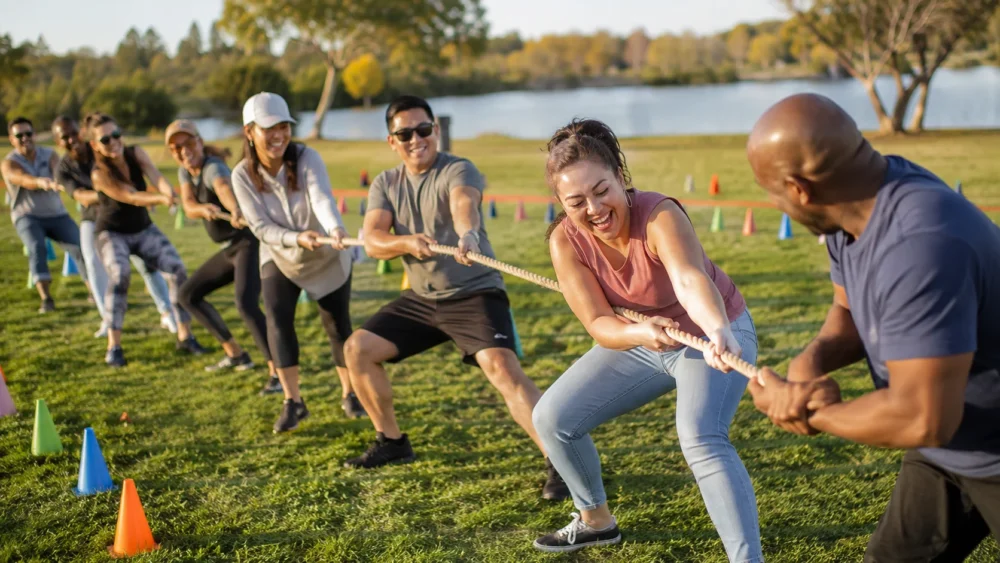
Diverse coworkers enjoying team building activities during a tug of war game on a grassy field beside a lake.

55+ Team Building Activities That Build Teamwork and Bring Your Team Together in 2026

Every team, no matter how long it’s been together, benefits from time spent outside the usual meetings and deadlines. Team building activities give coworkers a reason to talk, laugh, and solve small problems together, which builds the kind of trust that carries back into everyday work long after the activity ends.

This guide rounds up over 65 tested games and exercises, organized by format so you can find the right fit fast. Whether you’re planning a five minute warm up or a full afternoon retreat, you’ll find icebreakers, problem solving challenges, virtual options, and a few genuinely unique picks in the sections below.

What Are Team Building Activities and Games?

These sessions are structured group exercises designed to strengthen how a team communicates, trusts, and works together. Some are quick icebreakers meant for the start of a meeting, while others are longer team building games built around problem solving, creativity, or physical cooperation. The format changes, but the underlying goal stays the same.

At their core, these are activities that build teamwork by giving people shared, low stakes experiences outside their normal job duties. A well chosen pick, whether that’s icebreaker games for work or something bigger like workplace team building exercises, can improve morale and help new hires feel like part of the group faster than meetings alone ever could.

How to Choose the Right Team Building Activity for Your Team

Picking the right activity comes down to a few practical factors rather than guesswork. Team booster activities that work beautifully for a group of six can fall flat with sixty people, and a game built for a conference room won’t translate to a fully remote team. Walk through these four questions before you commit to a format.

  • Group size: 

Small teams can handle deeper, more personal exercises like storytelling or two truths and a lie. Team building activities for large groups need something built to scale instead, like scavenger hunts or a trivia night.

  • Goals and skills: 

Decide what you actually want to improve first, communication, creativity, or trust. A trivia night builds different muscles than a blindfolded rope challenge does.

  • In-person vs. remote:

 Remote teams need activities that translate to a screen, like virtual trivia or a photo caption contest. In-person teams can take on physical or outdoor challenges instead.

  • Time and setting: 

A packed meeting schedule calls for a five minute icebreaker, not an hour long build challenge. Simple office team building activities work best when saved for retreats or dedicated team days instead.

What Frogbridge Offers for Team Building Days

Reading about good activities is one thing that actually running them somewhere your whole team can spread out and breathe is another. Frogbridge Events is an 86-acre resort in Millstone Township, New Jersey, and our team has coordinated team building days and corporate retreats for numerous Fortune 500 companies. Every package below is included on-site, without needing outside vendors, extra rentals, or a separate facilitator to run it.

Category What’s Included
Water-Based Challenges  Kayak relays, pedal boat races, and bumper boat competitions on our private lake 
Land-Based Games & Relays  Tug of war, water balloon toss, treasure hunt, and relay races as part of our Team Spirit packages 
Sports & Fields  Soccer fields, tennis courts, basketball courts, bocce and horseshoes, beach volleyball, mini golf, and a driving range 
Premium Add-Ons  Go-kart track, outdoor laser tag, extreme ziplining, and spin zone bumper cars (available for an additional fee) 
Entertainment & Staffing  DJ, a Team Spirit Leader, professional staff, custom signage, and medals for winning teams 
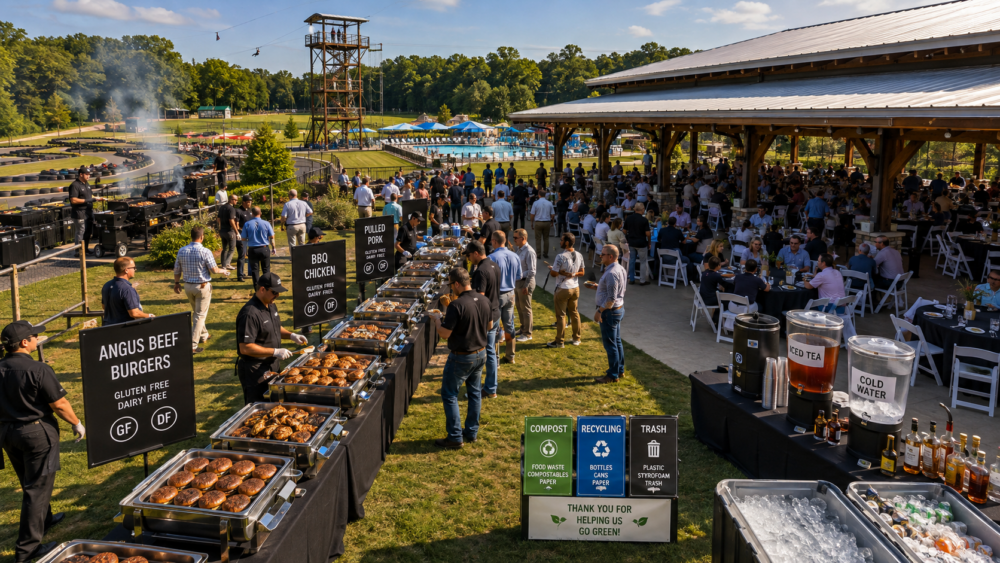
Catering  Continuous catering under a private covered pavilion from our on-site chef, William Towle, a Johnson & Wales University-trained culinarian, off-the-grill staples, specialty stations, and upgrade menus like Clam Bakes and Smokehouse BBQ, with gluten-free, vegetarian, vegan, and halal options available 

Our standard team building package runs five hours of non-stop music and activities with exclusive access to the property, and everything above is fully customizable to your group’s size and goals. Everything past this table is general inspiration pulled from research on great team activities everywhere. You’re welcome to run any of these yourself with your own team, or bring them up when you call. Our event planner can often work several of these ideas directly into an actual day booked on our grounds, whether that’s a team building day, a full corporate retreat, or a school or company picnic. 

Team Building Icebreaker Games

Team building icebreaker games are the fastest way to warm up a room before the real agenda starts. They work just as well for introducing new hires as they do for teams who’ve worked together for years. Use these icebreaker games for team meetings whenever you need a quick, low pressure way to get everyone talking.

1. Two Truths and a Lie

  • Team Size: 3+ people
  • Time: 2–3 minutes per person

Purpose

Breaks the ice with new or unfamiliar teammates. Turns simple facts into natural conversation starters.

How to Play

Ask everyone to think of two true facts about themselves and one convincing lie. Each person shares all three statements while the group tries to guess which one isn’t true. The more surprising the truths and the more believable the lie, the more fun the round becomes for everyone involved.

Why This Exercise Is Great

This game works best with teams who don’t know each other well yet. The details people share often become natural follow-up questions later, giving coworkers an easy way to keep the conversation going after the game ends.

2. Penny for Your Thoughts

  • Team Size: 5+ people
  • Time: 2–3 minutes per person

Purpose

Gives every teammate a low pressure way to share a personal story. Works well as a warm opener for any meeting.

How to Play

Fill a jar with coins minted no earlier than your youngest teammate’s birth year. Have each person draw one coin and share a memory, milestone, or story from that specific year printed on it, whether that’s learning to ride a bike, moving to a new city, or landing a first job.

Why This Exercise Is Great

This puts a fun spin on a simple icebreaker, giving every teammate a chance to share something personal. Run multiple rounds if stories are short, or let people elaborate for a deeper look into each other’s lives.

3. Mood Pictures

  • Team Size: 5+ people
  • Time: 2–3 minutes per person

Purpose

Helps a facilitator read the room before a meeting starts. A creative, low stakes way to talk about feelings.

How to Play

Lay out a variety of images, magazine cutouts, postcards, or printed photos showing landscapes, people, and shapes in different colors. Ask each teammate to pick whichever image matches their current mood or their expectations for the meeting, then explain to the group why they chose it and what it says about how they’re feeling.

Why This Exercise Is Great

A picture is worth a thousand words, so this makes talking about feelings easier for people who find that hard to put into sentences. It’s a great way to open a workshop with something visual and unexpected.

4. One Word Exercise

  • Team Size: 3+ people
  • Time: 5–10 minutes

Purpose

Collects honest opinions before a meeting begins. Helps facilitators gauge the room in seconds.

How to Play

Pick a phrase tied to the meeting topic and ask everyone to write down the first word that comes to mind. Gather the words on a whiteboard or shared doc so the whole group can see them at once. If the words trend negative, it’s worth pausing to ask why.

Why This Exercise Is Great

This stays well within most people’s comfort zone while still surfacing real concerns. Reading the room before diving into a topic makes the rest of the meeting more useful for everyone in it.

5. Back-to-Back Drawing

  • Team Size: 4+ people
  • Time: 5–10 minutes

Purpose

Sharpens listening skills through a fun communication challenge. Works well for pairs who don’t usually talk much.

How to Play

Split the team into pairs sitting back to back. Show one partner a simple image, like a house or a flower, and have them describe only its shapes, sizes, and textures so the other can draw it, without ever naming the object itself. Compare drawings to the original once time is up.

Why This Exercise Is Great

This is a fun, low stakes way to sharpen listening skills. It also gives teammates a reason to think creatively about how to describe something clearly without relying on the obvious word for it.

6. Birthday Line Up

  • Team Size: 8+ people
  • Time: 10–15 minutes

Purpose

Builds nonverbal communication and cooperation. A fast way to get a whole team moving together.

How to Play

Ask the entire team to line up in order of their birthdays, month and day only, without speaking to each other at all. Gestures, sign language, and nudges are fair game. Add a time limit if you want to raise both the pressure and the laughter in the room a bit.

Why This Exercise Is Great

Besides learning everyone’s birthday, which comes in handy later as a conversation starter, this exercise pushes the team to work toward a shared goal using only nonverbal communication and patience.

7. Charades

  • Team Size: 8–10 people
  • Time: 10–25 minutes

Purpose

A classic way to break up a mentally heavy day. Gets everyone laughing without needing any prep.

How to Play

Split into groups of four or five. Show the first player an object, like a stapler or a keyboard, and have them act out how to use it without speaking or showing the object. Their team gets a set time to shout out the answer before the turn passes on.

Why This Exercise Is Great

This classic game is a nice way to break up a mentally taxing day. It gives the team a creative, work free exercise that gets everyone laughing within the first couple of rounds.

8. Common Thread

  • Team Size: 10+ people
  • Time: 30 minutes

Purpose

Surfaces surprising commonalities between coworkers. Especially useful for teams that feel a bit divided.

How to Play

Divide the team into groups of three to five and ask each group to find things every member has in common, favorite shows, ice cream flavors, hobbies. Push them to go past the obvious answers. If time allows, bring the whole team back together so each group can share what they found.

Why This Exercise Is Great

Finding real commonalities that people wouldn’t normally discover at work can help reconnect a team that’s started to feel a little divided or distant from each other lately, especially after a stretch of remote or heads down work.

Quick Get To Know You Team Building Activities

Quick get to know you games are built for teams still learning each other’s names, or established teams who want a fresh way to reconnect. These get to know you games for work need almost no setup, which makes them an easy addition to any meeting, onboarding session, or team offsite agenda.

9. 3 Question Mingle

  • Team Size: 2–40 people
  • Time: 30–60 minutes

Purpose

Combines structure with self direction so people ask what they genuinely want to know. Great for early stage teams.

How to Play

Each person writes three questions on sticky notes, then finds a partner for a one minute meeting. They each ask the other one question, trade sticky notes, and move on to a new partner. Keep the mingling going until most of the room has connected with someone new at least once.

Why This Exercise Is Great

This gets an entire team moving and talking while letting people ask the questions they actually want answered, rather than ones a facilitator picked for them ahead of time for the session.

10. Best and Worst

  • Team Size: 5–10 people
  • Time: 10–15 minutes

Purpose

Ignites conversation by letting people share both highs and lows. Works well for smaller, closer teams.

How to Play

Ask each participant to write one question about the best and worst version of something, like a favorite recipe or a worst injury ever sustained. Collect the questions in a hat, draw pairs at random, and invite the group to share their answers and the stories behind them out loud.

Why This Exercise Is Great

Pulling questions from a hat keeps things playful and unpredictable, and the stories that come out often reveal sides of teammates that don’t usually surface during a normal workday together.

11. Group Order

  • Team Size: 5+ people
  • Time: 5–10 minutes

Purpose

Gets a room talking fast with almost no setup. A reliable energizer for the start of any session.

How to Play

Ask the group to line themselves up based on a simple criterion, distance from home to the office, birth month, or number of countries visited so far in life. No talking is required to start, but people quickly begin comparing notes to figure out exactly where they belong in the line.

Why This Exercise Is Great

This needs nothing more than a room and a group willing to move around, and it reliably gets people comparing notes and talking with each other within the first minute or two.

12. Happiness Exercise

  • Team Size: 4–30 people
  • Time: 10–20 minutes

Purpose

Builds a positive atmosphere by focusing on joy rather than problems. Useful after a stressful stretch.

How to Play

Ask each teammate to share one thing that genuinely makes them happy, a hobby, a small daily ritual, or a favorite memory from earlier in life. Go around the group so everyone gets a turn, and let people ask follow up questions if a particular story catches their interest along the way.

Why This Exercise Is Great

Sharing joyful, low stakes stories helps defuse tension after a difficult stretch and reminds a team that there’s more to each other than the current workload sitting in front of them.

13. Name Juggling

  • Team Size: 5+ people
  • Time: 1–15 minutes

Purpose

Reinforces name recall through movement and light strategy. Ideal for brand new teams.

How to Play

Stand in a circle and have everyone introduce themselves by name. Introduce a ball, and have the holder say another person’s name before tossing it to them. That person thanks the sender by name, then passes it on. Once it’s smooth, add a second or third ball to raise the challenge.

Why This Exercise Is Great

This turns the usually awkward process of learning new names into something active and a little competitive, which makes the names stick far better than a simple round of introductions.

14. Open Fist

  • Team Size: 3+ people
  • Time: 5–10 minutes

Purpose

Finds common ground quickly by limiting how much people can share. Easy to slot into any agenda.

How to Play

Ask each person to hold up one open hand. Going around the group, teammates share one fact about themselves at a time, and anyone who shares that same fact folds down a finger. The goal is to find enough shared facts to close a full fist before time runs out.

Why This Exercise Is Great

Limiting the exercise to five facts keeps it quick and focused, and finding real overlap with coworkers tends to make a team feel more cohesive almost immediately after just one round.

Fun Team Building Activities

Sometimes the goal isn’t deep reflection, it’s just getting a team laughing together. These fun activities for team building are built to loosen up a room fast. Use these fun games to build teamwork whenever the day needs a lighter touch, and lean on these fun team building exercises anytime a meeting runs long or energy starts to dip.

15. Bang

  • Team Size: 10–40 people
  • Time: 5–30 minutes

Purpose

A fast, silly game that sharpens reactions and helps with name recall. Great opener for any size group.

How to Play

Stand in a circle with one person acting as sheriff in the middle. The sheriff spins and points at a player, shouting “bang.” That player crouches instantly while the two people beside them quickly point at each other and shout each other’s names as fast as they can. Whoever reacts too slowly is out.

Why This Exercise Is Great

The quick reactions and constant name calling make this a great early game for brand new teams, and it reliably gets a room laughing within the first couple of rounds.

16. Build-a-Shake

  • Team Size: 4+ people
  • Time: 5–10 minutes

Purpose

Brings out playful creativity through a shared, silly ritual. Works well for teams looking to bond quickly.

How to Play

Pair people up and ask each pair to invent a short secret handshake together. After a few minutes, have pairs rotate and teach their handshake to a new partner, building on what they learn along the way until most of the group is sharing some version of the same growing routine.

Why This Exercise Is Great

This taps into the same creativity most people had as kids, and teaching your handshake to a new partner each round is a genuinely easy way to build closeness fast.

17. Count Up

  • Team Size: 10–40 people
  • Time:5–30 minutes

Purpose

Demonstrates the power of quiet, coordinated teamwork. Simple to run with no materials needed.

How to Play

As a group, try to count out loud from one to twenty with eyes closed, no assigned order, and no two people speaking a number at the same time. If two people talk over each other, the whole group starts over from one. Keep trying until you reach twenty cleanly.

Why This Exercise Is Great

This looks simple but takes real focus and awareness, and it’s a surprisingly effective way to show any team exactly what calm, coordinated listening actually feels like in practice together.

18. Follow the Leader

  • Team Size: 2+ people
  • Time: 5–20 minutes

Purpose

Builds group cohesion through observation and a bit of silliness. Works equally well online or in person.

How to Play

Designate one person as leader and have everyone else copy their movements exactly as closely as they possibly can. On video calls, switch to gallery view so everyone can see and follow along easily. Rotate the leader every minute or two so different people get a turn setting the pace.

Why This Exercise Is Great

Being a little silly together tends to produce genuine laughter fast, and rotating the leader role means everyone gets a turn setting the tone for the group at some point.

19. Portrait Gallery

  • Team Size: 2–40 people
  • Time: 30–60 minutes

Purpose

Turns a simple drawing exercise into a colorful, collaborative keepsake. Great icebreaker for larger groups.

How to Play

Split the group into two teams. One team draws portraits of the other, but every ten to fifteen seconds, the drawing gets passed to a new artist to continue where the last one left off. By the end, every person on the other team has a genuinely collaborative portrait made by several teammates.

Why This Exercise Is Great

The resulting gallery of portraits is colorful and a little chaotic, and passing drawings between artists breaks the ice fast, even in a group that’s never worked together before this.

20. Snowball

  • Team Size: 8–50 people
  • Time: 20–40 minutes

Purpose

Combines movement with anonymous sharing for a playful energy boost. Good fit for larger, energetic groups.

How to Play

Ask a question relevant to the group and have everyone write an answer on a sheet of paper. Crumple the papers into snowballs and have a real snowball fight in the middle of the room together. After a few minutes, everyone grabs one snowball and tracks down whoever wrote it.

Why This Exercise Is Great

The physical snowball fight gets people out of their seats fast, and hunting down the person who wrote each answer naturally sparks conversations that wouldn’t happen otherwise during a normal day.

21. Rock, Paper, Scissors (Tournament)

  • Team Size: 4+ people
  • Time: 5–10 minutes

Purpose

A quick, loud energizer that builds excitement before a bigger activity. Needs zero setup or materials.

How to Play

Pair everyone off for a game of rock, paper, scissors, and have losers become fans of the winner as the bracket advances round by round. Keep pairing off winners until only two players remain for a final showdown, cheered on loudly by the rest of the group who lost earlier rounds.

Why This Exercise Is Great

Watching a crowd of former opponents cheer on the finalists creates real, shared excitement fast, and it’s a fun way to warm a group up before something more involved starts.

Indoor Team Building Activities

Indoor team building activities are the easiest option when the weather doesn’t cooperate or your office is the only space available. Most of these indoor team building games fit inside a conference room or open hallway, and several scale up nicely if you want to include a larger group without leaving the building.

22. Perfect Square

  • Team Size: 4–12 people
  • Time: 15–30 minutes

Purpose

A blindfolded trust and communication exercise. Reveals how well a small team listens under pressure.

How to Play

Split into groups of four to six standing in a tight circle, blindfolded, holding a length of rope. Without looking, the group has to pass the rope around and arrange it into a perfect square using only verbal instructions. Lay the rope down and remove blindfolds to check the result.

Why This Exercise Is Great

Because nobody can see what they’re doing, this becomes a genuine test of clear verbal communication, and it’s often hilarious to see how imperfect the final squares turn out to be.

23. Memory Wall

  • Team Size:5+ people
  • Time: 15–30 minutes

Purpose

Ends a long day or workshop on a warm, shared note. Simple to run with just sticky notes.

How to Play

Write a few work related themes on a whiteboard, like first day at work or favorite team celebration. Hand out sticky notes and ask everyone to jot down a favorite memory tied to one theme, then invite people to share and post their notes on the wall as they go.

Why This Exercise Is Great

Taking a walk down memory lane like this is a nice way to close out a long week or multi day workshop, leaving the team with something to smile about.

24. Paper Plane

  • Team Size: 6–12 people
  • Time: 20–30 minutes

Purpose

Combines quick design thinking with a fun physical competition. Great for a tight timeline.

How to Play

Split into pairs or small groups and hand out card stock. Give each team ten to fifteen minutes to design the best long distance paper plane they can, plus a name for their airline. Line up in a hallway or outside afterward and see whose plane flies the farthest overall.

Why This Exercise Is Great

This forces fast collaboration under a tight timeline, which makes it a solid way to practice delegation and time management without anyone in the group feeling any real added pressure.

25. Build a Tower

  • Team Size: 8–16 people
  • Time: 20–30 minutes

Purpose

A classic engineering challenge that rewards fast prototyping. Works well for larger teams split into small groups.

How to Play

Divide into groups of four or five and give each team twenty sticks of uncooked spaghetti, tape, string, and one marshmallow to work with. Challenge every team to build the tallest freestanding tower that can support the marshmallow on top, all within a strict twenty minute time limit set in advance.

Why This Exercise Is Great

Watching towers succeed or collapse under a countdown clock says a lot about how well a team prototypes, communicates, and adjusts a plan once the first attempt fails badly halfway through.

26. Flip It Over

  • Team Size: 6–8 people
  • Time: 20–30 minutes

Purpose

A funny, physical test of cooperation. Needs only a blanket or sheet to run.

How to Play

Lay a blanket or sheet on the floor and have the whole team stand on it. The challenge is to flip the fabric completely over without anyone stepping off it or touching the floor around it. Make it harder by shrinking the sheet or adding more people to the group.

Why This Exercise Is Great

This oddly difficult task demands real cooperation and a good sense of humor, and it’s a fast, physical way to see how well a team improvises together under a little pressure.

27. Sneak a Peek

  • Team Size: 4–20 people
  • Time: 30 minutes

Purpose

Tests communication under a strict time crunch. A fun twist on a basic building challenge.

How to Play

Build a small Lego structure ahead of time and hide it in another room. Split into groups with their own Lego pieces, and let one rotating scout per team sneak a fifteen second look at the original before running back to describe it. First team to match the structure wins.

Why This Exercise Is Great

Since only one scout at a time gets to look, teammates end up describing different details, which makes clear, specific communication the real skill being tested throughout this whole exercise.

28. Pyramids

  • Team Size: 8–24 people
  • Time: 30 minutes

Purpose

A relay style race that rewards teamwork under time pressure. Fun as a mid-day energy break.

How to Play

Line teams up with space between each player and give the first person in line ten paper cups. That player builds a four cup pyramid, then the next player helps carry it to the next station without letting it collapse, toppling and rebuilding it there before handing off to the next runner.

Why This Exercise Is Great

The constant rebuilding and careful carrying makes this a fun, fast paced way to practice teamwork and communication during any mid-day break in a longer event or a full workshop day.

29. Team Flag

  • Team Size: 6–20 people
  • Time: 30–45 minutes

Purpose

Surfaces shared values through a creative design task. Great for teams defining their identity.

How to Play

Split into small groups and hand out paper and pens. Each group designs an emblem or flag that represents their team’s identity, then presents it to everyone else, explaining the choices behind the design and exactly how the group landed on their shared values along the way through open discussion.

Why This Exercise Is Great

Designing and presenting a shared symbol pushes a group to actually talk through their values together, which makes this more meaningful than a typical drawing exercise ever could hope to be.

Outdoor Teamwork Games

Outdoor team building activities take advantage of fresh air and open space in a way no conference room ever could. For more inspiration built around a picnic style event, our guides to Top 8 Company Picnic Games and the Complete List of 55+ Corporate Picnic Themes, Games and Activities cover plenty more outdoor team building games worth adding.

30. The Minefield

  • Team Size: 4–10 people
  • Time: 15–30 minutes

Purpose

A trust exercise built entirely on verbal communication. Works best outdoors or in a large open room.

How to Play

Scatter cones, balls, and bottles across an open space to create a minefield. Pair up, blindfold one partner, and have the other guide them across using only spoken directions from a safe distance. The blindfolded partner can’t talk and is eliminated if they step on an object or stop moving.

Why This Exercise Is Great

This is as much a trust exercise as a listening one, since the blindfolded partner has to rely completely on clear, calm directions to make it across the field safely.

31. Earth-Ball

  • Team Size: 5–20 people
  • Time: 15–45 minutes

Purpose

A high energy game that gets everyone moving at once. No skill required, just teamwork and quick reflexes.

How to Play

Stand in a circle with a balloon, beach ball, or volleyball and try to keep it in the air as long as possible. The only rule is that no one can touch it twice in a row. Track your best streak and try to beat it as a team each new round.

Why This Exercise Is Great

The bigger the group, the more fun this gets, and trying to beat your own record naturally pushes the whole team to communicate and strategize on the fly together as one.

32. Scavenger Hunt

  • Team Size: 8+ people
  • Time: 45–90 minutes

Purpose

A flexible outdoor challenge that scales to almost any group size. Easy to tailor to your company.

How to Play

Build a list of photos to take or items to collect around the property, a company logo shot, a specific colored leaf, or a signature from a manager. Group people who don’t know each other well, and offer a small prize for the fastest or most creative team of the day.

Why This Exercise Is Great

Tailoring the list with company specific inside jokes or trivia gives the hunt personality, and grouping unfamiliar teammates together gives quieter people a natural reason to bond quickly and easily.

33. Egg Drop

  • Team Size: 4–12 people
  • Time: 60–90 minutes

Purpose

A hands on engineering challenge with a dramatic finale. A memorable way to close out a longer event.

How to Play

Give small teams a raw egg plus tape, straws, rubber bands, and newspaper, then set a sixty minute limit to build a structure that protects the egg from a second or third story drop below. Gather everyone for the grand finale to see whose careful design actually survives the fall.

Why This Exercise Is Great

Designing under a countdown clock forces real collaboration fast, and the dramatic drop at the end gives the whole team a shared, memorable moment to close the entire day on together.

34. Team Outing

  • Team Size: Any
  • Time: Any

Purpose

A flexible, low pressure way to bond outside the office. Works for any budget or group size.

How to Play

Plan a shared experience away from the usual work environment, a cooking class, a museum trip, a bowling night, or a casual 5K run together as a group. The specific activity matters less than the setting, somewhere new where casual conversation flows more naturally than it does across a conference table.

Why This Exercise Is Great

Taking the team somewhere new lowers the usual professional distance, and casual conversation tends to flow far more easily at a restaurant or a park than it ever does at a desk.

35. Volunteer as a Team

  • Team Size: 5+ people
  • Time: Any

Purpose

Builds bonds through shared purpose rather than competition. Doubles as a genuine benefit to the community.

How to Play

Organize a team volunteer event during regular work hours, a charity drive, a local park cleanup, or packing meals for a food bank for the community. Scheduling it as paid time signals that this is a real perk rather than an extra obligation stacked on top of everyone’s already busy workload.

Why This Exercise Is Great

Sharing the feeling that comes from doing good together tends to bond a team on a deeper, more lasting level than most competitive games out there ever manage to do.

Physical Team Building Activities

Physical team building activities ask a group to solve a problem with their bodies, not just their words. These team building physical activities tend to produce the fastest, most visible results because a team either figures out the coordination together or the whole exercise falls apart in front of everyone watching.

36. Blind Square – Rope Game

  • Team Size: 4–20 people
  • Time: 40–45 minutes

Purpose

Tests planning and communication under a blindfold. A reliable favorite for facilitators.

How to Play

Tie a length of rope into a circle and give the group a few minutes to plan how they’ll shape it into a perfect square. Blindfold everyone, then give the team ten minutes to form that square using only the plan they made together and verbal coordination in the dark.

Why This Exercise Is Great

This delivers reliable results with almost any group, since it clearly reveals whether a team over-plans, under-communicates, or quietly lets just one single person take over the whole task alone.

37. Crocodile River

  • Team Size: 10–40 people
  • Time: 60–120 minutes

Purpose

A large scale physical challenge built on mutual support. Best suited to bigger teams outdoors.

How to Play

Mark out a wide stretch of open space as the river and challenge the group to get everyone across to the other side. The only way across is by physically supporting one another, so the team has to figure out a strategy together before anyone can safely make the crossing.

Why This Exercise Is Great

Changing the setting to something physically demanding stretches a team’s problem solving muscles while also putting their leadership and patience under a bit of healthy shared pressure together for once.

38. Helium Stick

  • Team Size: 5+ people
  • Time: 5+ minutes

Purpose

A famously tricky exercise that looks simple on paper. Needs zero setup or materials to run.

How to Play

Have the group hold out their index fingers and balance a long, light pole across them. The challenge is to lower the pole all the way to the ground while every finger stays in contact with it the entire time, which is far harder than it sounds at first try.

Why This Exercise Is Great

The pole tends to rise instead of lower at first, which makes for an instant, honest lesson in how easily a group’s instincts can work against its own stated goal.

39. Lego Challenge

  • Team Size: 10–40 people
  • Time: 60–120 minutes

Purpose

Explores how hidden assumptions shape group dynamics. A creative, hands on building exercise.

How to Play

Give the team a shared pile of Lego and a structure to build together, but hand each person a private, secret assignment that shapes how they’re allowed to contribute to it. Watch how the group negotiates around these hidden constraints while still trying to finish a cohesive final structure on time.

Why This Exercise Is Great

The hidden assignments quietly surface leadership dynamics, conflict, and genuine cooperation that a normal building exercise usually keeps completely invisible until the very end of the entire shared session together.

40. Marshmallow Challenge

  • Team Size: 6–100 people
  • Time: 45–60 minutes

Purpose

A time pressured design sprint with a satisfying visual result. Works for teams of nearly any size.

How to Play

In just eighteen minutes, small teams build the tallest freestanding structure they can using twenty sticks of spaghetti, some tape, string, and exactly one marshmallow, which has to sit right on top when time runs out. Debrief afterward by asking who took the lead and how roles shifted along the way.

Why This Exercise Is Great

The built in debrief about roles and leadership is what separates this from a simple building game, turning eighteen chaotic minutes into a genuinely useful discussion for the whole team.

41. Spider Web

  • Team Size: 6–20 people
  • Time: 15–30 minutes

Purpose

A trust building challenge with a physical puzzle at its center. Best run outdoors with some space.

How to Play

Build a web of string or rope between two poles, with several gaps of different sizes woven all through it. Challenge the group to get everyone through a gap safely, without anyone touching the string, and without reusing the same gap twice for more than one person in the group.

Why This Exercise Is Great

The constraint of not reusing gaps forces real problem solving and physical trust between teammates, since bigger people often need real, hands on help fitting through the smaller openings safely enough.

Team Building Problem Solving Activities

Teamwork problem solving activities push a group past their usual routines and into genuine collaborative thinking together. These team building problem solving activities work well whenever you want to practice decision making under a deadline, without the real stakes of an actual work project hanging over the exercise the whole time.

42. Your First Idea

  • Team Size: 5–12 people
  • Time: 10–20 minutes

Purpose

Uncovers overlooked solutions by skipping overthinking. Works with a real problem or a fictional one.

How to Play

Present the group with a real or fictional problem and ask everyone to write down the very first idea that comes to mind. Compile the list and review it together. As a fun twist, ask for everyone’s worst idea instead and see how many turn out to be workable after all.

Why This Exercise Is Great

We often overthink problems until the obvious answer gets buried, so writing down that first instinct can uncover a genuinely useful fix that was hiding in plain sight the whole time.

43. Back of the Napkin

  • Team Size: 6–24 people
  • Time: 15–20 minutes

Purpose

Forces fast, creative thinking under a tight constraint. A quick way to spark new ideas.

How to Play

Split into groups of two to four and hand each team an open ended problem, real, fictional, or environmental in nature. Give them a single napkin and pen to sketch or write out their solution before pitching it back to the rest of the room in a quick, informal presentation.

Why This Exercise Is Great

Some of history’s best ideas have reportedly started on napkins, and this exercise recreates that same scrappy creativity while still asking the team to collaborate on a genuinely real answer.

44. Spectrum Mapping

  • Team Size: 5–15 people
  • Time: 30–60 minutes

Purpose

Visualizes how diverse a team’s opinions really are. Useful before a big decision.

How to Play

Write a few discussion topics on a whiteboard and hand out sticky notes. Ask everyone to write their opinion and post it under the relevant topic, then work together to arrange similar ideas toward one side and outlier opinions toward the other, forming a visible spectrum of thought for everyone.

Why This Exercise Is Great

Seeing the full spread of opinions laid out visually helps a team notice that unpopular ideas aren’t automatically wrong, which often unlocks a genuinely useful new perspective for the whole group.

45. What Would “X” Do?

  • Team Size: 5–10 people
  • Time: 45–60 minutes

Purpose

Breaks people out of their own head by borrowing someone else’s perspective. Fun and a little theatrical.

How to Play

Present the group with a real problem and ask each person to pick a leader or public figure they admire. Challenge everyone to solve the problem as if they were that person, channeling their mindset and decision making style, with bonus points for really committing to the character the whole time.

Why This Exercise Is Great

Stepping into someone else’s mindset often unlocks solutions a person would never have reached while stuck inside their own usual, everyday way of thinking about a stubborn problem entirely alone at their desk.

46. Team Pursuit

  • Team Size: 6–24 people
  • Time: 1–3 hours

Purpose

A multi challenge competition that gives every skill set a chance to shine. Great for team days.

How to Play

Split into small competing groups and run them through a series of challenges: logic puzzles, physical skill tests, and open ended creative tasks to solve. Buy a ready made team pursuit kit online, or build your own series of challenges tailored specifically to your group’s interests and shared inside jokes.

Why This Exercise Is Great

Because the challenges cover logic, skill, and creativity, everyone gets at least one real moment to shine, which shows teammates sides of each other they genuinely hadn’t really seen before now.

47. Code Break

  • Team Size: 8–24 people
  • Time: 1–3 hours

Purpose

A competitive brain teaser that works indoors or out. Scales down easily into smaller groups.

How to Play

Run a series of coded clues and puzzles that teams have to crack in sequence to progress through the course from start to finish. Self hosted kits and fully guided, professionally run versions are both available if you’d rather not build the entire puzzle trail from scratch on your own.

Why This Exercise Is Great

Breaking a large group into smaller competing teams keeps the challenge manageable while still creating a genuinely competitive, creative thinking environment for absolutely everyone involved in the whole day’s event.

48. Escape Room

  • Team Size: 3+ people
  • Time: 2–3 hours

Purpose

A ready made problem solving adventure with no setup required. Reveals real strengths under pressure.

How to Play

Book a local escape room and pick a theme the whole group will enjoy, whether that’s history, horror, or science fiction. If you have the time and creativity, you can even build a simple version of your own using a locked room, a handful of clues, and a countdown timer.

Why This Exercise Is Great

Solving the mystery together tends to reveal a team’s real strengths and weaknesses fast, while building the kind of shared memory that sticks with a group long after the event ends.

Board Games & Retreat Activities

Board games for team building are an easy way to spark collaboration without any prep, equipment rental, or facilitator required. If you’re planning a retreat, our full breakdown of 3 Top Team Building Board Games for a Company Retreat goes deeper on which team building board games work best for a longer, more relaxed event.

49. Codenames

  • Team Size: 4–8 people
  • Time: 15–30 minutes

Purpose

A word association game that rewards creative, careful thinking. Great for smaller, mixed groups.

How to Play

Split into two teams, each with a spymaster who gives one word clues pointing to several cards their own team needs to guess correctly and quickly. The rest of each team debates and guesses based on the clue, racing to identify all their words before the other team finishes first overall.

Why This Exercise Is Great

Giving a good clue means thinking the way your whole team thinks, which makes this a surprisingly sharp lesson in perspective taking disguised as a genuinely fun party game for everyone.

50. Pandemic (Cooperative Board Game)

  • Team Size: 2–4 people per table
  • Time: 45–60 minutes

Purpose

A fully cooperative game where the whole team wins or loses together. Builds shared strategy fast.

How to Play

Everyone plays on the same side, working together to stop four diseases from spreading across a shared game board before precious time runs out completely. Each player has a different role with unique abilities, so the group has to coordinate closely and plan several moves ahead together as one single unit.

Why This Exercise Is Great

Because there’s no winner within the team, only a shared win or loss, this naturally pushes collaborative planning instead of the usual competitive instincts most board games tend to bring out.

51. Ticket to Ride

  • Team Size: 2–5 people per table
  • Time: 45–60 minutes

Purpose

A light strategy game that mixes friendly competition with easy conversation. Simple for anyone to pick up.

How to Play

Each player builds train routes across a map, collecting matching color cards to claim connections between cities before opponents can grab them first instead of you. The rules are simple enough to explain in just a couple of quick minutes, which keeps the focus on conversation rather than complicated strategy.

Why This Exercise Is Great

The easy learning curve means new players jump in fast, and the light competitive tension keeps a whole table talking and laughing for the length of the entire game together.

52. Jenga Team Challenge

  • Team Size: 3–6 people per table
  • Time: 20–30 minutes

Purpose

Adds a team twist to a familiar classic. Rewards patience and steady hands under pressure.

How to Play

Play a standard game of Jenga, but write a discussion prompt or challenge on each block beforehand of time. Whenever a player pulls a block, they answer the prompt or complete the small challenge before placing it carefully back on top, all while trying hard not to topple the whole tower.

Why This Exercise Is Great

Turning a familiar game into a discussion prompt machine gets people sharing between turns, which builds far more genuine conversation than a standard, ordinary round of Jenga usually ever does on its own.

Virtual Team Building Games

Virtual team building activities close the distance that remote work naturally creates, keeping scattered teams feeling like one group instead of a list of names on a calendar. These are worth keeping in your back pocket for hybrid teams between in-person events, or as a quick warm-up in the weeks leading up to a full day on-site. Schedule them during normal work hours and pick ones that fit every time zone so nobody feels left out. 

53. Show and Tell

  • Team Size: 3+ people
  • Time: 2–3 minutes per person

Purpose

A grown up version of a classic kids activity. Easy to run on any video call.

How to Play

Ask everyone to bring something to the next call that they’re proud of or that brings them real joy, a pet, a plant, a certificate, anything meaningful at all. Give each person two to three minutes to show their item and answer a couple of questions from the rest of the team.

Why This Exercise Is Great

Show and tell isn’t just for kids, it reliably surfaces something new about a teammate and hands the group a fresh conversation starter to use at the next meeting too.

54. Photo Caption Contest

  • Team Size: 5+ people
  • Time: 10–15 minutes

Purpose

A quick creative laugh built around shared humor. Great fit for busy remote schedules.

How to Play

Collect a few funny photos or recent memes ahead of the call and send them to the whole team beforehand as a heads up. Ask everyone to submit their best caption for each image, then present all the entries together and vote as a group on the funniest one overall.

Why This Exercise Is Great

This is a genuinely fun way to get creative together in just a few minutes, and reading everyone’s captions out loud almost always gets a real laugh from the group.

55. Morning Coffee

  • Team Size: 3+ people
  • Time: 15–30 minutes

Purpose

Recreates casual office chit chat for a scattered team. Easy to run on a recurring schedule.

How to Play

Schedule a regular, casual video call for small groups of four or five, or randomly pair up two people at a time instead of a big group. Offer it weekly, biweekly, or monthly depending on interest, and keep the conversation loose and unstructured, just like a real coffee break would feel.

Why This Exercise Is Great

Remote teams rarely get a chance to simply chit chat without an agenda, so a regular, casual call gives people who don’t usually interact a genuinely real reason to bond over time.

56. Lunch and Learn

  • Team Size: 5+ people
  • Time: 30 minutes

Purpose

Blends casual bonding with genuine learning. A nice change of pace from typical meetings.

How to Play

Host a weekly or monthly session where one teammate presents something during everyone’s lunch break, a favorite tool, a lesson from a recent project, or a book worth reading closely together. If budget allows, send a small lunch stipend along too so people can eat comfortably while they listen in.

Why This Exercise Is Great

These sessions strike a nice balance between casual and educational, and covering the cost of lunch makes the whole thing feel like a genuine perk rather than even more work.

57. Online Group Game

  • Team Size: 3+ people
  • Time: 30–60 minutes

Purpose

Swaps work talk for pure, unstructured fun. Works with almost any shared game or app.

How to Play

Invite the team to play an online game together, whether that’s an actual video game everyone can join in or a screen shared party game like a Jackbox title instead. Pick something simple enough that nobody needs any prior experience at all to jump in and have a genuinely good time.

Why This Exercise Is Great

Playing something that has nothing to do with work is a genuinely easy way to switch gears, and it gives the naturally competitive people on the team a fun chance to shine.

58. Trivia Games

  • Team Size: 6–20 people
  • Time: 30–90 minutes

Purpose

A competitive, educational way to bond remotely. Doubles as an easy team building trivia games format.

How to Play

Open a meeting with a quick round of trivia, or run a full virtual trivia night at the end of a long day. Mix genuinely useful company facts with lighter topics like movies or music, and rotate who hosts each round to keep the whole format feeling fresh over time.

Why This Exercise Is Great

Whether the questions are office themed or completely random, trivia gives a scattered team a genuinely competitive, entertaining reason to spend real time together outside of the normal daily work talk.

59. Quarterly Challenge

  • Team Size: 3+ people
  • Time: One month

Purpose

Builds accountability around personal goals rather than work output. Purely optional and low pressure.

How to Play

Create an optional monthly challenge centered on something like healthy eating, meditation, journaling, or reading more books often than usual. Set up a shared chat or thread where teammates post wins, questions, and encouragement throughout the month to keep each other accountable and genuinely motivated along the entire way together.

Why This Exercise Is Great

A shared challenge like this shows the team you genuinely care about their life outside of work, and having built in support makes it far easier for people to actually follow through.

5-10 Minute Team Building Activities

Not every session has room for a full activity, which is exactly what 5 minute team building activities are for. These five minute team building exercises fit neatly into the first few minutes of any meeting, giving a team a quick reset without eating into the actual agenda for the day.

60. One-Word Pulse Check

  • Team Size: 3+ people
  • Time: 5 minutes

Purpose

A near instant read on how the team feels. Perfect for opening a sensitive meeting.

How to Play

Ask everyone to submit exactly one word describing their thoughts on a current project or topic, either on a shared doc or a whiteboard for everyone to see. Read the words out loud together once everyone has submitted, and use whatever pattern emerges to shape how the rest of the meeting goes.

Why This Exercise Is Great

Gauging group sentiment in a single word takes almost no time at all, but it can reveal exactly where a team’s head is at before you dive into anything heavier.

61. Rapid-Fire Questions

  • Team Size: 3+ people
  • Time: 5–10 minutes

Purpose

Keeps energy high with fast, light hearted answers. No prep needed from anyone.

How to Play

Prepare a short list of fun, easy questions, favorite snack, dream vacation, first job ever held down. Go around the group quickly, giving each person just a few seconds to answer before moving on to the next person, keeping the pace brisk enough that nobody has time to overthink their response.

Why This Exercise Is Great

The speed is the whole point here, since quick, unfiltered answers tend to be far more honest and genuinely revealing than anything people would have time to carefully plan out in advance.

62. Desk Safari

  • Team Size: 5+ people
  • Time: 5–10 minutes

Purpose

A playful mini scavenger hunt using only what’s already at hand. Works for remote and in-office teams alike.

How to Play

Give everyone exactly sixty seconds to grab the strangest, oldest, or most personal item within arm’s reach of their desk or workspace nearby. Go around the group so each person shows their item and explains the story behind it, then vote together on the most unexpected find of the round.

Why This Exercise Is Great

This needs zero prep at all and works just as well over video as it does in person, turning whatever happens to be sitting on someone’s desk into a fun little story.

63. The Compliment Circle

  • Team Size: 4+ people
  • Time: 5–10 minutes

Purpose

A quick morale boost built entirely on genuine appreciation. Great way to close out a hard week.

How to Play

Stand or sit in a circle and go around one at a time, with each person giving a short, genuine compliment to the teammate seated right there on their right side. Keep it specific rather than generic, focused on something that person actually did recently that the whole group appreciated.

Why This Exercise Is Great

A few seconds of genuine appreciation goes a long way, and closing a tough week with real compliments tends to leave a whole team feeling noticeably lighter going into the weekend.

64. Speed Networking Pair-Up

  • Team Size: 6+ people
  • Time: 5–10 minutes

Purpose

Gets people talking to teammates they rarely interact with. Especially useful for larger, siloed teams.

How to Play

Pair everyone up randomly and give each pair a full ninety seconds to chat about anything at all not related to work. When time is up, call out a brand new random pairing and repeat two or three more times so people talk with several different teammates in a short window.

Why This Exercise Is Great

Random pairing forces conversation across departments and seniority levels that would rarely happen otherwise on a normal day, which makes this activity especially useful for larger or more siloed teams overall.

65. Word Association Chain

  • Team Size: 4+ people
  • Time: 5–10 minutes

Purpose

A fast, playful way to build focus and quick thinking. Needs absolutely no materials to run.

How to Play

Start with one simple word and go around the group, with each person saying the first word that comes to mind based on the previous answer given. Keep the chain moving quickly without long pauses, and see how far the conversation wanders from where it originally started by the end.

Why This Exercise Is Great

Watching the chain wander somewhere completely unexpected is usually the best part, and the quick pace keeps everyone mentally present and engaged instead of quietly drifting off during the exercise itself.

How to Make Inclusive Team Building Activities Work for Everyone

Not every activity suits every person, and that’s fine as long as you plan around it. A few small adjustments make team bonding activities genuinely welcoming for the whole group.

  • Consider all abilities: physically demanding games may exclude some teammates, so offer a non physical alternative alongside anything blindfolded or highly active.
  • Balance social comfort: introverts often prefer small group formats over big, highly interactive exercises performed in front of the whole team.
  • Ask before assuming: a quick anonymous poll reveals real interest levels and comfort zones before you lock in a format for everyone.
  • Bring in outside help: a professional facilitator can design fun team bonding activities that feel natural rather than forced for a nervous group.
  • Keep participation optional: nobody should feel pressured into any exercise, since the best team building activities are ones people genuinely choose to join.

Benefits of Team Building Activities

  • Team building activities for work don’t have to feel like extra work themselves. Done well, they strengthen communication and trust across the whole team, not just within existing friend groups.
  • Fun team building activities give people something to look forward to, which measurably lifts everyday morale and energy.
  • Team building activities for employees at every level help new hires build real relationships faster than small talk ever could.
  • Team building games for adults introduce healthy, low stakes competition that keeps energy high without any real pressure attached.
  • Team building activities for adults with busy lives outside work still make room for something purely fun and shared.
  • Team building physical activities build resilience, since solving problems under pressure together mirrors how a team handles real setbacks at work.
  • Team bonding games and deeper exercises alike create shared memories and inside jokes that quietly strengthen culture over time.
  • Gives remote and hybrid teams a genuine sense of connection despite the physical distance between them.
  • Improves collaboration on real projects long after the actual activity is over.
  • The best team development activities pay for themselves many times over in morale, retention, and long term collaboration.

FAQs About Team Building Activities & Games

How often should teams do team building activities?

Most teams benefit from something small monthly and a bigger event quarterly. Short five minute activities during meetings help keep connection steady between sessions.

What are the best team building games for small groups?

Team building activities for small groups work best when they get personal, like Penny for Your Thoughts, Open Fist, or a quick round of Two Truths and a Lie.

What are the best team building activities for remote teams?

Remote team-building games like Show and Tell, Trivia Games, and Morning Coffee translate well to video calls and help scattered teams feel like one group again.

How long should a team building activity last?

It depends on the format. Quick icebreakers work well in 5 to 10 minutes, while bigger challenges like escape rooms or retreats deserve 45 minutes to a few hours.

What games should we play at a corporate picnic?

Our Complete List of 55+ Corporate Picnic Themes, Games and Activities covers everything from Office Olympics to lawn games, giving you a full outdoor lineup beyond this list.

What board games are good for team building?

Our 3 Top Team Building Board Games for a Company Retreat breaks down which titles work best for a relaxed, longer retreat instead of a quick office session.

Plan Your Next Team Building Event With Frogbridge

Not every venue that promises a great team day actually delivers one. At Frogbridge, the difference is in what’s already here: 86 acres of sports fields, a private lake, go-karts and laser tag, and a dedicated event planning team that manages every detail from arrival to last call. We’ve brought that same level of care to Fortune 500 companies and growing teams alike, whether the goal is a half-day team-building package, a multi-day corporate retreat, or a company or school picnic. 

If you’re searching for team building activities near me in Central New Jersey, our grounds put icebreakers, outdoor challenges, and problem-solving games all in one place. Call (609) 208-9475 or email us at info@frogbridgeevents.com to start planning your team’s next day together. 


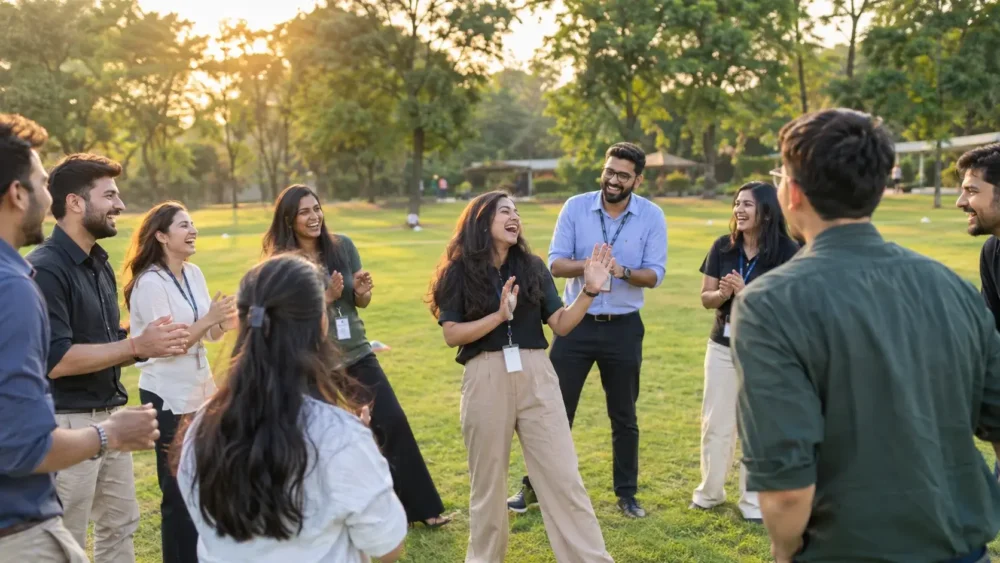
Icebreaker Questions & Games activity with a diverse group of professionals laughing, clapping, and participating in a fun team-building game outdoors on a sunny green lawn.

200+ Team Building Icebreaker Questions & Games for Work Meetings [Ultimate 2026 Guide]

Every meeting has those first sixty seconds when nobody knows what to say. A good icebreaker is what turns that awkward pause into an actual conversation, and it takes less effort than most people think. Icebreaker questions and games delight your team and help build connections. They level up your work meetings, help relax the group, and set up the right tone in under a minute.

At Frobridge Events, we host in-person team-building days on our own 86-acre grounds in Millstone, New Jersey. We know firsthand which icebreakers get a room laughing in ten seconds and which ones fall flat. That experience shaped this list.

What Makes a Good Icebreaker? 

An icebreaker only has one job: get people talking or moving without having any real agenda. That’s it. 

  • Icebreaker questions are the simplest version of this. You ask one question, people answer it, and the meeting moves on. They need zero setup, which is why they’re the most common icebreaker for work meetings. A good ice breaker question is easy to answer in one or two sentences. It doesn’t require anyone to overshare.
  • Icebreaker games need a little more planning. Games like two Truths and a Lie, a quick trivia round, or a virtual scavenger hunt share laughter and create opportunities for storytelling. Games work best when you actually have five or ten minutes to spare.

How to Choose the Right Icebreaker for Your Team

Picking the right icebreaker at random is how you level up your meetings and build connection. A few quick questions about your group and your meeting will point you to the right one almost every time.

By Group Size 

The smaller groups of under 15 people are very useful for creating working groups and building cohesion between teams. The most common icebreakers are interview icebreaker, magic box, paper telephone, human knot, coat of arms, life maps, and LEGO metaphors.

Medium groups of 10 to 30 people do best with structured formats. Like this-or-that questions, one-word check-ins, or short games with clear rules.

Large-group icebreakers create a positive, energetic vibe for your meeting. Polls, chat waterfalls, “stand up if” style questions keep everyone engaged.

By Time Available 

If you have two minutes, stick to a single question with a one-word or one-sentence answer. In five minutes, you can do a Rock, Paper, Scissors Tournament. During fifteen minutes, you have time for like a scavenger hunt, a group challenge, or a few rounds of a get-to-know-you game.

By Setting 

In-person icebreakers can use physical space, movement, and props. Virtual icebreakers work best with chat-based questions, polls, and webcam activities for event enhancement. 

By Meeting Goal

A quick warm-up before a status meeting just needs something light and fast. A team-building session has more time to spend on games that build trust or require actual collaboration. A meeting for deeper connection, like a retreat or an all-hands, can support more personal or reflective questions. 

Quick-Start Icebreaker Table

You can choose the perfect icebreaker for the moment, according to time.

Icebreaker Type Best For Time Needed
One-word check-in  Any meeting, any size  Under 2 minutes
This or That questions  Medium to large groups  3 to 5 minutes 
Would You Rather  Small to medium groups  5 minutes 
Two Truths and a Lie  Small groups, new teams  10 to 15 minutes 
Virtual scavenger hunt  Remote or hybrid teams  10 to 20 minutes 
Deep connection questions  Small groups, retreats  15-plus minutes 
Rock Paper Scissors Tournament  Large in-person groups  5 to 10 minutes 
Trivia round  Any size, virtual or in-person  10 minutes 
Team scavenger hunt or relay Team-building days, retreats 20-plus minutes

Question-Based Icebreakers

Best Icebreaker Questions for Work Meetings

These are the all-purpose icebreaker questions for work that fit almost any meeting, team, or industry. Pull one at random when you’re short on time, and it’ll fit the room without needing any extra context or setup. 

  1. What’s one word you’d use to describe your week so far?
  2. What’s the best piece of advice you’ve ever gotten at work?
  3. If you could swap jobs with anyone on this team for a day, who would it be?
  4. What’s a small win you’re proud of this week?
  5. What’s your go-to productivity trick when you’re stuck?
  6. What was your very first paying job?
  7. What’s one skill you’d like to get better at this year?
  8. What’s a book, show, or podcast you can’t stop thinking about?
  9. If your work week had a theme song, what would it be?
  10. What’s something you learned recently that surprised you?
  11. What’s your favorite way to unwind after a long day?
  12. What’s one thing on your desk that always makes you smile?
  13. What’s a project you’re genuinely excited about right now?
  14. If you had an extra hour in your day, how would you spend it?
  15. What’s the most useful app or tool you use daily?

Quick Ice Breakers 

When the agenda is packed, these two-minute icebreaker questions get people talking without eating into your meeting time. Every answer fits in a word or two, so a group of ten finishes before the first agenda item starts. 

  1. Coffee or tea?
  2. What’s your energy level right now, on a scale of one to five?
  3. Morning person or night owl?
  4. What’s one emoji that sums up your day?
  5. Sweet or savory breakfast?
  6. What’s playing in your headphones this week?
  7. Cats, dogs, or neither?
  8. What’s the last thing you added to your online cart?
  9. Beach vacation or mountain trip?
  10. What’s your comfort food?
  11. Window seat or aisle seat?
  12. What’s one word for how you’re feeling about this week?
  13. Text message or phone call?
  14. What’s your current phone wallpaper?
  15. Early meeting or late meeting, which do you prefer?

This or That Icebreaker Questions

Rapid-fire and low-pressure, this or that icebreaker questions are the fastest way to get a whole room talking at once. There’s no right answer and nothing to prepare, so even the quietest person jumps in easily. 

  1. Pizza or tacos?
  2. Working from home or working from the office?
  3. Netflix or a good book?
  4. Beach or mountains?
  5. Morning workout or evening workout?
  6. Sweet coffee or black coffee?
  7. Group chat or one-on-one texts?
  8. Camping or a hotel?
  9. Salty snacks or sweet snacks?
  10. Planning every detail or going with the flow?
  11. Karaoke or trivia night?
  12. Email or Slack?
  13. Road trip or flight?
  14. Summer or winter?
  15. Standing desk or sitting desk?
  16. Comedy or drama?
  17. Cooking at home or ordering in?
  18. Big city or small town?
  19. Early bird or night owl?
  20. Physical planner or digital calendar?

“Would You Rather” Icebreaker Questions

Would You Rather questions work because there’s no wrong answer, only an interesting one. They give people something to defend, which turns a simple check-in into a real conversation. These land just as well on video as in person. 

  1. Would you rather have unlimited PTO or a 4-day workweek?
  2. Would you rather work in total silence or with constant background noise?
  3. Would you rather give a presentation with no slides or write a 10-page report?
  4. Would you rather have every meeting be 15 minutes shorter, or every meeting start 15 minutes later?
  5. Would you rather be famous for something small or completely unknown but very successful?
  6. Would you rather have the ability to skip Mondays or add an extra Saturday every week?
  7. Would you rather read minds or see 24 hours into the future?
  8. Would you rather never use email again or never use your phone for calls again?
  9. Would you rather work from a beach with spotty wifi or a quiet cabin with none?
  10. Would you rather have an extra hour of sleep or an extra hour after work?
  11. Would you rather be able to teleport anywhere or freeze time for an hour a day?
  12. Would you rather have a personal assistant or a personal chef?
  13. Would you rather always be 10 minutes early or always finish 10 minutes early?
  14. Would you rather never have to commute again or never have another meeting run over?
  15. Would you rather have the loudest laugh in the room or the quietest?

Funny Ice Breaker Questions

Nothing loosens up a room faster than a genuinely funny ice breaker question. One laugh in the first minute changes the mood of an entire meeting. Keep them light and let the group run with the best answer. 

  1. What’s the weirdest food combination you actually enjoy?
  2. If you had a talk show, what would you name it?
  3. What’s the most useless talent you have?
  4. What’s your go-to karaoke song, even if you’d never admit it?
  5. What’s the worst gift you’ve ever received?
  6. If you were a kitchen appliance, which one would you be and why?
  7. What’s a trend from the past you secretly miss?
  8. What would your entrance music be if you walked into every meeting like a boxer?
  9. What’s the strangest job you’ve ever applied for?
  10. If your pet could talk, what’s the first thing they’d complain about?
  11. What’s your most-used autocorrect fail?
  12. What’s a food you refuse to eat, no matter how it’s prepared?
  13. If you had to survive on one snack forever, what would it be?
  14. What’s the most embarrassing song on your playlist?
  15. What fictional job would you actually be good at?

Deep Ice Breaker Questions

For teams who already know each other’s names and want to go a level deeper, these questions open real conversation and company picnic vibes. Save them for retreats and small groups, and always give people the option to pass.

  1. What’s a piece of advice you’d give your younger self on day one of this job?
  2. What does a genuinely good day at work look like for you?
  3. What’s something you’ve changed your mind about in the last few years?
  4. Who’s someone who shaped how you approach your career?
  5. What’s a challenge you’ve overcome that most people here don’t know about?
  6. What does support look like to you when you’re stressed at work?
  7. What’s a value you won’t compromise on, at work or in life?
  8. What’s something you’re still figuring out professionally?
  9. What accomplishment are you proudest of that isn’t on your resume?
  10. What’s a moment that changed how you think about your career path?
  11. What do you wish more people understood about your role?
  12. What’s a habit that’s genuinely made your work life better?
  13. What’s something you learned from a failure that stuck with you?
  14. Who has believed in you at a time you needed it most?
  15. What does “success” look like to you five years from now?

Icebreakers to Get to Know Each Other

These questions are built for one purpose: helping coworkers actually get to know each other beyond job titles and calendar invites. They work especially well for new teams, recent hires, or departments that only cross paths over email. 

  1. Where did you grow up, and what’s one thing people don’t expect about it?
  2. What’s your favorite way to spend a weekend?
  3. What’s a hobby you picked up recently?
  4. What’s your go-to order at your favorite restaurant?
  5. What’s a place you’ve traveled to that you’d go back to in a heartbeat?
  6. What’s something on your bucket list?
  7. What’s a skill you have that has nothing to do with your job?
  8. What was your first concert or live show?
  9. What’s a family tradition you still keep up?
  10. What’s your favorite season and why?
  11. What’s a hidden talent you rarely get to show off?
  12. What’s the last thing that made you laugh out loud?
  13. What’s something you collect, or used to collect?
  14. Who’s someone in your life you’d want everyone here to meet?
  15. What’s a small thing that always makes your day better?

Team Building Icebreakers Questions

Our team-building icebreakers focus on how the group works together, not just individual trivia. That makes them a strong fit for kickoffs, retreats, and offsites. A few also surface honest feedback about how your team communicates. 

  1. What’s one thing this team does really well?
  2. If our team had a mascot, what would it be and why?
  3. What’s a project this team is proud of?
  4. What’s one word you’d use to describe how we work together?
  5. What’s something you appreciate about a teammate that you’ve never said out loud?
  6. If we had an unlimited budget for one team outing, where would we go?
  7. What’s a strength you bring to this team that isn’t in your job description?
  8. What’s one thing you’d change about how our team communicates?
  9. What’s a team win from this year that deserves more credit?
  10. If our team were a sports team, what position would you play?
  11. What’s something you’ve learned from a teammate?
  12. What’s a tradition you’d like to start for this team?
  13. What makes you feel like part of this team?
  14. What’s a challenge we’ve tackled together that made us stronger?
  15. If you could give this team one piece of advice, what would it be?

Workplace Icebreaker Questions

Straightforward and professional, these icebreaker questions for team meetings fit any department meeting, all-hands, or client call. Nothing asks anyone to share personal details, which keeps them safe for mixed groups or meetings with outside guests. 

  1. What’s a tool or resource you couldn’t do your job without?
  2. What’s one goal you’re working toward this quarter?
  3. What’s the best piece of feedback you’ve ever received?
  4. What’s a workplace habit you’re trying to build?
  5. What’s something about your role that surprised you when you started?
  6. What’s a meeting format you actually enjoy?
  7. What’s one way you like to celebrate a win at work?
  8. What’s your favorite part of your current role?
  9. What’s a professional goal you’re proud of reaching?
  10. What’s a piece of career advice you’d give someone just starting?
  11. What does a productive Monday look like for you?
  12. What’s one thing that helps you focus when you’re overwhelmed?
  13. What’s a work skill you’ve picked up outside of formal training?
  14. What’s your favorite way to give feedback to a teammate?
  15. What’s one thing you’d want a new hire to know on day one?

Travel & Food Icebreaker Questions

Travel and food are two of the easiest topics for people to talk about, which makes these questions reliable with any group. Almost everyone has an opinion on a good meal, so nobody gets stuck searching for an answer. 

  1. What’s the best meal you’ve ever had?
  2. What’s a destination on your travel wish list?
  3. What’s a local restaurant you always recommend to visitors?
  4. What’s the most adventurous food you’ve ever tried?
  5. What’s your go-to comfort meal?
  6. If you could only eat one cuisine for the rest of your life, what would it be?
  7. What’s the strangest place you’ve ever eaten a meal?
  8. What’s your favorite city you’ve ever visited?
  9. What’s a dish you make that always gets compliments?
  10. What’s a food you loved as a kid but can’t stand now?
  11. What’s the best road trip snack?
  12. What’s a country you’d move to for a year if you could?
  13. What’s your favorite holiday meal?
  14. What’s a restaurant you’d fly somewhere just to eat at again?
  15. What’s a travel mishap that turned into a good story?

Throwback Icebreaker Questions

Nostalgia is an easy way to get people smiling before a meeting starts. These throwback icebreaker questions send everyone back a few years, and the answers usually pull the biggest laughs of any category on this list. 

  1. What was your first job, and what did it pay?
  2. What was the first CD, cassette, or album you ever owned?
  3. What was your favorite show as a kid?
  4. What trend from your teenage years do you wish would come back?
  5. What was your dream job when you were 10 years old?
  6. What was the first concert you ever went to?
  7. What’s a toy or game from your childhood you still think about?
  8. What was your go-to outfit in high school?
  9. What was the first movie you saw in a theater?
  10. What was your first email address, and how embarrassing was it?
  11. What’s a phrase or slang word you used constantly as a teenager?
  12. What was your first car, or the car you learned to drive in?
  13. What’s a school subject you loved that you never use now?
  14. What was your favorite family vacation growing up?
  15. What’s a video game you spent way too many hours playing?

Hypothetical Icebreaker Questions

Hypotheticals give people permission to be a little creative, which makes them a fun break from anything work-related. Nobody has to reveal anything true about themselves, so they’re a safe pick for groups still warming up. 

  1. If you could have any superpower for one workday, what would it be?
  2. If you won the lottery tomorrow, what’s the first thing you’d do?
  3. If you could instantly master one new skill, what would it be?
  4. If you had to give up your phone or your laptop for a month, which would you keep?
  5. If you could live in any decade, which would you choose?
  6. If you could have dinner with anyone, living or not, who would it be?
  7. If you were a kitchen gadget, which one would you be?
  8. If you had to be famous for one thing, what would you want it to be?
  9. If you could add one holiday to the calendar, what would it be?
  10. If you could trade lives with anyone for a week, who would it be?
  11. If you could only keep three apps on your phone, which would they be?
  12. If our office had a theme song, what would it be?
  13. If you could time travel but only forward, how far would you go?
  14. If you had to start a business tomorrow, what would it be?
  15. If animals could talk, which one would be the rudest?

Virtual Team Icebreaker Questions

Built specifically for remote and hybrid calls, these virtual team icebreaker questions work through a screen with zero setup. They rely on whatever is already sitting in each person’s room, so there’s nothing to mail out beforehand. 

  1. What does your current workspace look like right now?
  2. What’s the last thing you ordered online?
  3. What’s your favorite virtual background, real or joke answer welcome?
  4. What’s one thing on your desk you can’t work without?
  5. What time zone are you dialing in from, and what does your day look like?
  6. What’s the last show you binged?
  7. What’s your go-to snack during a long call?
  8. What’s one thing you’d add to your home office if budget wasn’t a factor?
  9. What’s the weather like where you are right now?
  10. What’s your favorite productivity app right now?
  11. What’s a household task you’ve done during a boring meeting? No judgment.
  12. What’s the most-used mug in your kitchen?

These are good for the video call before the trip. The real connection happens once your team is standing on the same field.

Activity-Based Icebreakers

Questions get people talking, but games get people moving. This section covers icebreaker games sorted by time and group size, from quick meeting-starters to full team building activities that need a bit more room to run. 

1. Ice Breakers for Meetings

These entertainment games are built for the start of a regular meeting, quick enough to run without eating into the agenda but engaging enough to actually shift the room’s energy before the real discussion begins. 

1.1. Two Truths and a Lie: 

Each person shares three statements about themselves. Two are true, and one is false, and the group guesses which one is the lie. It works because it’s simple to explain and always reveals something surprising.

1.2. Rock Paper Scissors Tournament:

Pair everyone off for a quick round of Rock Paper Scissors. Losers become fans cheering for their former opponent, and the bracket continues until two people face off for the win. 

1.3. One-Word Check-In:

Ask everyone to share a single word that describes how they’re feeling or how their week is going. It takes under a minute total but gives the meeting a quick read.

1.4. What’s on Your Mind:

Ask each person to name one thing, work-related or not, that’s taking up mental space right now. 

1.5. Show and Tell:

Ask everyone to grab something within arm’s reach and explain why it matters to them. It’s an easy way to learn something personal about a coworker in under thirty seconds.

1.6. Celebrate a Win:

Go around and have each person share one recent win, personal or professional. 

1.7. Weather Check-In:

Ask people to describe their current mood using weather, like “partly cloudy with a chance of a big deadline.” 

1.8. Would You Rather Rapid Fire:

Run through three or four quick would-you-rather questions back to back. It’s fast, funny, and works equally well in person or on video.

2. 5-Minute Icebreaker Games

When you actually have five minutes to spare, these icebreaker games add more energy than a single question. Each one has clear rules and a natural stopping point, so the meeting stays on schedule. 

2.1. Speed Networking:

Pair people up for 90-second rapid conversations, then rotate. It’s especially useful for larger teams or new hires who haven’t met everyone yet.

2.2. Count to Twenty:

As a group, count out loud from one to twenty with no set order and no two people speaking at once. If two people talk over each other, the count restarts. It sounds simple but surprisingly effective way to build focus fast.

2.3. Line Up:

Ask the group to line themselves up by a random criterion, like birth month or distance from the office, without speaking. It builds quick non-verbal teamwork and always ends in a few laughs.

2.4. Chat Waterfall:

Ask a question, have everyone type or write their answer, then reveal all the answers at once. The simultaneous reveal creates a fun burst of shared reactions.

2.5. Desert Island Picks:

Ask each person which three items they’d bring to a desert island. It’s a lighthearted way to see how people think and prioritize under a silly hypothetical.

2.6. Name That Tune:

Play the first five seconds of a few popular songs and have the group guess. It’s an easy energizer for a Friday meeting or right after lunch.

3. Virtual Icebreaker Games

Remote and hybrid teams need icebreaker games that translate through a screen. These are built specifically for that, relying on chat, webcams, and whatever’s already within reach instead of physical props. 

3.1. Virtual Scavenger Hunt:

Call out an item, like “something blue” or “a mug with a logo,” and have everyone race to find it and hold it up on camera.

3.2. Emoji Check-In:

Ask everyone to describe their mood using only emojis in the chat. It’s fast, expressive, and low-pressure since nobody has to unmute.

3.3. Change Three Things:

One person turns off their camera and changes three small things about their appearance or background. Then turns it back on for the group to guess what changed. 

3.4. Guess the Desk:

Collect a close-up photo of everyone’s workspace ahead of time and have the group guess whose is whose. It works especially well for teams that have never met in person.

3.5. Background Story:

Ask each person to share the story behind their virtual background or the room they’re sitting in. It’s an easy conversation starter.

3.6. Poll Party:

Run three or four quick this-or-that polls using your video platform’s built-in poll feature. 

4. Small Group Ice Breakers

Groups under 10 people can handle more personal or involved icebreaker activities since everyone gets a real turn without the meeting running long. These work especially well for new teams still learning each other. 

4.1. The Interview Game:

Pair people up, give each pair three minutes, and have one person interview the other before switching roles. It naturally leads to deeper conversation.

4.2. Common Ground:

In pairs or trios, give the group two minutes to find three things they all have in common that aren’t work-related.

4.3. Coat of Arms:

Have each person sketch a simple personal “coat of arms” divided into sections. Like a hobby, a value, and a career highlight, then share it with the group.

4.4. Paper Telephone:

Everyone writes a sentence, passes it to the next person, who draws it, then passes that drawing to be turned back into a sentence, and so on around the group. The final results are almost always funnier than expected.

4.5. Magic Box:

Fill a box or bag with random small objects. Each person picks one without looking and explains what it says about them.

5. Icebreakers for Large Groups

Big groups need icebreaker games that don’t require going person by person. These keep everyone involved at the same time, so a room of fifty moves just as fast as a room of five. 

5.1. Stand Up If:

Ask a series of “have you ever” or “stand up if” questions, like “stand up if you’ve traveled to more than five countries.” People self-select in and out, so the whole room participates without anyone needing to speak.

5.2. Group Map:

Ask everyone to imagine the room as a map and physically move to the spot representing where they grew up or where they live now. It’s a fast way to visualize how spread out a large team really is.

5.3. Human Bingo:

Hand out bingo cards filled with statements like “has run a marathon” or “speaks three languages.” Everyone mingles to find people who match each square. It works especially well at larger in-person picnics and events like a retreat or an all-hands.

5.4. Passions Tic-Tac-Toe:

Each person fills a 3×3 grid with personal interests, then walks around comparing grids with others to find matches. Whoever fills a line first wins, but the real value is the conversations it sparks along the way.

5.5. Lifeboat Debate:

Break the large group into smaller teams and give each a hypothetical scenario. Like defending why their assigned “character” deserves a spot on a sinking lifeboat.

6. Team Building Icebreaker Games

These team building icebreaker games ask groups to actually work together, not just answer a question. That makes them a strong fit for retreats, offsites, and any event built around real collaboration. 

6.1. The Marshmallow Challenge:

Give small teams spaghetti, tape, string, and a marshmallow. Then challenge them to build the tallest free-standing structure with the marshmallow on top in 18 minutes.

6.2. Human Knot:

A group of 7 to 16 people links hands randomly across a circle, then has to untangle themselves without letting go. 

6.3. Helium Stick:

A group holds a light rod on their fingertips and has to lower it to the ground together without anyone losing contact. It sounds easy, as the stick keeps rising instead of falling, which usually gets a good laugh.

6.4. Scavenger Hunt:

Give small teams a list of items or challenges to complete within a time limit. It forces delegation and communication under a bit of friendly pressure.

6.5. Egg-on-a-Spoon Relay:

Teams race to keep an egg balanced on a spoon across a finish line without touching it. Same coordination-under-pressure payoff as Egg Drop, minus the cleanup.

6.6. Tug of War:

Zero setup, works for any group size, and the rivalry does the rest. It’s a staple of our own team-building packages at Frogbridge. 

6.7. Kayak or Relay Race:

Kayak Relay and Bump Boat Race, both actual Frogbridge water activities, with a line noting they include certified lifeguards.  

6.8. Trust Walk:

Pair people up; blindfold one partner. It’s a simple way to build communication and trust between coworkers who don’t usually collaborate closely.

Tips for Running Icebreakers Without Awkwardness

An icebreaker only works if people actually want to join in. A few small habits make the difference between a room that engages right away and one that answers in an awkward silence. 

Explain the Purpose First

People engage more when they know why they’re doing something. A single sentence, like “let’s do a quick icebreaker to shift gears before we dive into the agenda,” is usually enough to get buy-in from the group.

Set an Example / Go First

If you’re leading the icebreaker, answer the question or demonstrate the game yourself before asking anyone else. It shows the group exactly what’s expected and takes the pressure off the first volunteer.

Keep Time Limits Clear

Tell the group how long the icebreaker will take before you start. A clear time limit keeps things moving and prevents one long answer from eating the whole meeting.

Let Participants Choose the Next Person

Instead of calling on people yourself, have each person pick who goes next after they answer. It keeps the energy moving and gets the group talking to each other instead of just to you.

Mistakes to Avoid When Running Icebreakers

Even a good icebreaker question can fall flat if it’s run the wrong way. A few common mistakes show up again and again.

  • Skipping the explanation
  • Picking something too personal for a group
  • Letting one icebreaker run long
  • Using the same icebreaker every single meeting
  • Forcing participation always backfires

After the Icebreaker: How to Keep the Energy Going

An icebreaker is only useful if it actually carries into the rest of the meeting. A few small habits help bridge the gap. Reference something someone shared during the icebreaker later in the meeting if it’s relevant, since it shows people you were actually listening. If the icebreaker revealed a shared interest between two team members, mention it, since small connections like that tend to stick.

If your team is ready to go beyond a quick warm-up question, our team-building packages combine relay races, water-based challenges, and friendly competition across our 86-acre resort in Millstone, New Jersey. A team-building day that includes lunch from our Johnson & Wales-trained chef keeps that energy going well past the last icebreaker. 

Plan Your Next Team Building Day at Frogbridge

Icebreakers are a great start, but nothing builds a team quite like a full day away from the desk. Pair a great icebreaker with a full day of food from our Johnson & Wales-trained culinary team. At Frogbridge Events, we host team-building days and corporate retreats across 86 acres in Millstone, New Jersey, combining relay races, water-based team challenges, and friendly competition that Fortune 500 companies have trusted for years. If your team has outgrown the meeting-room icebreaker and is ready for something bigger, contact our team at (609) 208-9475 or email us at info@frogbridgeevents.com to start planning.

Frequently Asked Questions

What’s a good icebreaker question for a team meeting? 

A simple, low-pressure question works best for most team meetings, something like “what’s one word to describe your week” or “what’s a small win you’re proud of.

How many icebreaker questions should I ask? 

One is usually enough for a short meeting. For a longer session or a team-building day, two or three questions of increasing depth work better.

How do I make icebreakers less awkward for introverts? 

Give people the option to pass, avoid put-them-on-the-spot formats like unscripted public speaking, and consider written or chat-based answers.

What are good icebreakers for remote/virtual teams? 

Chat-based questions, polls, and webcam activities like a virtual scavenger hunt or show-and-tell work best for virtual teams.

How long should an icebreaker take? 

Most icebreaker questions take under two minutes. Icebreaker games typically run five to fifteen minutes depending on group size. 

What’s the difference between an icebreaker question and a game? 

A question is a single prompt that people answer out loud or in chat. A game requires some movement, interaction, and energy.

ChatGPT Image Aug 19, 2026, 11 49 12 PM

Indoor and Outdoor Event Venues: Which One’s Right for Your Party?

Which venue style best fits your event? Picking the right setup means comparing an indoor and outdoor event venue side by side. It is one of the first decisions in planning a corporate picnic, school outing, or day camp event. The choice for larger groups usually comes down to space, weather risk, and how hands-off you want the planning to be.

Below is what to expect from party venues in general. Then we’ll show you how Frogbridge Events, in Millstone, NJ, takes most of that outdoor guesswork off your plate. Here we go!

Why an Indoor Venue Might Be Your Best Bet

If you’re comparing indoor party venues versus outdoor party venues, here’s the case for going indoors. You control the temperature, the lighting, and where a sound system sets up. A predictable day with fewer surprises usually beats an open-sky view for this kind of gathering.

Benefits of Choosing an Indoor Venue

You’re not just staying dry. Most indoor spots come with tables, chairs, restrooms, and sometimes a full kitchen already in place, and parking tends to be simpler than at an outdoor site.

Weather-Proof, Year-Round Reliability

Rain, snow, or a heat wave won’t touch your plans indoors. You can book any month of the year without checking a forecast.

Climate Control & Guest Comfort

Nobody wants to sweat through a toast or shiver through a keynote. Indoor spaces let you set the room to whatever temperature keeps everyone comfortable.

Better Acoustics & Tech Setup

Indoor venues keep speeches and music sounding clear, while built-in lighting, outlets, and AV options make setup easier. You’ll spend less time managing equipment and more time enjoying the event. 

Fewer permits and restrictions

Indoor corporate event venues are mostly sorted out for permits for noise, capacity and alcohol service. That’s less paperwork on your end, and more time for the details that matter.

Things to Consider for an Indoor Party

Indoor isn’t automatically the easier choice. Some spaces are more formal or boxed in than an open field, so match the venue to the vibe you’re going for.

Type of Event & Formality Level

  • Corporate events: require reliable Wi-Fi, space for a quick presentation and a setup that can transition from a meeting to a casual lunch.
  • School trips: require space for children to move around; unobstructed views for supervision; food service that can serve a large group quickly.
  • Day camps and youth programs: Want solid space, convenient group check-in and staff who are accustomed to being with a lot of kids at a time.

Budget considerations

Indoor venues vary greatly in price, and rental fees often include tables, chairs, and cleanup. Compare what’s bundled into the rate before deciding what fits your budget.

Décor Flexibility

Some venues restrict what you can hang, nail, or light for fire safety reasons. Ask early so your decoration plans, real candles included, aren’t rejected on the day.

Guest Count, Capacity & Accessibility

A room that fits 80 seated guests can feel tight once you add a stage or buffet line. Check ceiling height, parking, and accessibility too, especially for a large group.

Questions to Ask an Indoor Venue

  • What décor is allowed? Can we use real candles?
  • What’s the maximum capacity (seated vs. standing)?
  • Is there room for guests to move comfortably?

The Charm of Hosting Your Party Outdoors

There’s a reason open sky and fresh air win people over for larger group events. Outdoor party venues offer a backdrop and a sense of scale that four walls can’t match.

Benefits of Choosing an Outdoor Venue

Space is the biggest win outdoors. At Frogbridge Events, that means 86 acres in Millstone, NJ, with lakes, pools, sports fields, and activities like go-karts and zip lines already built in, so groups get a resort’s worth of things to do instead of an empty field. Add certified lifeguards, chef-led continuous catering, and a turnkey event planning team, and it’s a different experience entirely.

Natural Scenery & Photo-Ready Backdrops

Lakesides, open fields, and mature trees give you a backdrop no indoor décor can copy. Golden hour light alone makes outdoor party venues look their best in nearly every photo.

More Space & Flexible Layouts

Without walls in the way, you can run sports fields, activity zones, and dining areas at once, which makes outdoor event space rental ideal for large corporate or school groups.

Relaxed and Open-Air Vibe

Guests tend to relax more quickly outside, and children can run around without anyone having to worry about what might break. It’s a relaxed atmosphere that’s perfect for company picnics, school outings and day camp days.

Best Seasons for Outdoor Parties

Late spring through early fall usually offers the most reliable weather, with early summer and crisp fall afternoons as guest favorites for comfortable temperatures and good light.

Things to Consider for an Outdoor Party

Outdoor events come with more moving pieces. Weather is the biggest wildcard, so you’ll need a backup plan, plus permits and power that indoor venues usually already include.

Weather Backup Plan

Always have a rain plan for your outdoor event, whether that’s a tent, a nearby indoor space, or a flexible reschedule date. At Frogbridge, that planning is already built in, since our team has hosted Fortune 500 groups rain or shine for years.

Budget & Tent Costs

Tents, heaters, fans, and generators add up fast and can push your total cost higher than expected. At Frogbridge, five-hour all-inclusive packages fold these details into one quote.

Permits Required

Depending on where you’re hosting, you may need an outdoor event permit for amplified music, alcohol, or large tents. At Frogbridge, our planning team handles site permits as part of booking.

Guest Count, Capacity & Accessibility

Uneven grass and gravel paths can be tough on guests with mobility needs. Confirm pathways and restroom access ahead of time, whatever venue you choose.

Questions to Ask an Outdoor Venue

  • What’s the noise ordinance in the area?
  • Is amplified music allowed, or acoustic only?
  • What’s the venue’s rain plan? Is there an indoor backup space?

Let’s Find the Perfect Venue for Your Party

If you’re still deciding, think about your guest count, your budget, and how much of the planning you want to hand off. A generic outdoor lot means you’re managing tents, catering, and activities yourself. A turnkey outdoor corporate event venue means someone else already has.

Frogbridge Events offers 86 acres of outdoor space in Millstone, NJ, purpose-built for corporate picnics, school outings, and day camp and youth group programs. Our facilities include pools, sports fields, and activities like laser tag and zip lines already set up. Our chef-led catering, lifeguard-staffed pools, and full event planning team have supported groups from companies like Johnson & Johnson and L’Oréal. We bring that same turnkey experience to every group we host. Call (609) 208-9475 or email info@frogbridgeevents.com to start planning.

Frequently Asked Questions

Is it cheaper to host a party indoors or outdoors? 

It depends on the venue. Outdoor spaces sometimes need extra tent or generator rentals, while indoor venues contain an all-inclusive package.

What’s the best backup plan for an outdoor event? 

An indoor space or a covered pavilion is your safest backup for an outdoor event.

Is Frogbridge available for day camp and youth group programs? 

Yes. Frogbridge hosts day camp and youth organization programs throughout the season.

What questions should I ask a venue before booking? 

Ask about capacity, décor or activity rules, weather backup plans, permits, and what’s included in the rental price.

ChatGPT Image Aug 7, 2026, 06 48 47 PM

The Ultimate Outdoor Corporate Event Catering Guide: Menus, Tips & Ideas

Corporate events are for memories and enjoyment, but planning them according to demands and budget becomes difficult sometimes. It requires effort to make that idea into a real event. This guide walks through what actually goes into great outdoor corporate event catering: the planning, the menus, the staffing, the small logistics nobody thinks about until they go wrong.

At Frogbridge Events, this is exactly what our team handles for you. We’re a turnkey venue: one team manages the logistics, staffing, and menu, so you can just show up and enjoy the picnic instead of running it.

What Goes Into Great Outdoor Catering: Logistics & Staffing, Handled

Planning an outdoor corporate event takes more than picking a menu. You’re working around weather, terrain, power access, and how a couple hundred people are going to move through a space, and in summer, weather alone can throw off a whole day. Since all of these pieces affect each other, they really need to be planned together from the start, not bolted on separately.

The most underestimated part of a great outdoor event is having enough of the right staff. Even a fantastic caterer will struggle if there aren’t enough hands to keep food stocked, guests served, and the whole setup running. Below is a look at how we think about logistics, food safety, and staffing. The kind of detail most planning guides skip, and the kind of detail that’s already built into every Frogbridge event.

How to Plan Outdoor Catering Events for Corporate Gatherings

Outdoor corporate catering services require a different approach than a typical office lunch. Instead of working in a controlled indoor space, you’re balancing weather, terrain, guest movement, and access to power throughout the event. Start by locking in your guest count and venue layout, then build your menu and staffing plan around those details. It makes the rest of the planning process much easier.

Venue Logistics and Setup

A well-planned setup is what lets guests relax and staff work without scrambling. Before event day, someone needs to walk the site and check electrical access, ground conditions, and how people and food will move once everyone arrives. At Frogbridge, that’s our team’s job, but here’s what we’re actually checking for.

Power sources: 

The venue should have enough outlets for food warmers, blenders, coffee stations, or other catering equipment. Our site is already built for this, so it’s one less thing anyone has to solve on the fly.

Traffic flow: 

Set up food stations away from bathrooms, parking areas, and main entry points. A buffet line that blocks the path to the office bus or other busy walkways can quickly create unnecessary congestion.

Space and ground: 

Tables, chafing dishes, and rolling carts all need level, dry ground. A perfectly planned layout can fall apart if rain turns a grassy area to mud, which is exactly why we plan alternate ground and covered space into every event from day one.

Menu and Food Safety for Outdoor Events

Guests remember two things about outdoor picnic catering: whether the food was good, and whether it was still fresh three hours in. Food that travels well and holds its quality outdoors isn’t an accident; it’s chosen with the weather and the timeline in mind, and prepared with the kind of care that keeps cross-contamination off the table entirely.

Temperature control: 

In summer heat, cold food needs to be stored below 40°F and hot food above 140°F. This temperature will slow down bacterial growth. It’s the single biggest food-safety factor outdoors, and it’s monitored continuously by our culinary team throughout the event. 

Smart choices: 

A menu should suit both the season and the crowd. Our own Red, White & Blue Picnic menu is a good example: Angus Beef Burgers, BBQ Chicken, Carolina Pulled Pork, Country Potato Salad, all chosen because they hold up beautifully outdoors and are easy to serve to a large group without a line backing up.

Clear labeling: 

Every dish should list allergens and dietary tags. This protects guests and saves event managers from a dozen repeat questions.

Comfort and Weather

Once food safety is handled, guest comfort is the next priority and a good outdoor venue plans for a beautiful setting *and* a real weather backup, not just one or the other.

Shade and shelter: 

Tents, canopies, or natural tree cover near food stations keep both guests and dishes out of direct sun.

Weather backup: 

New Jersey summers are unpredictable, and “hope it doesn’t rain” isn’t a plan. At Frogbridge, every event includes access to a private, covered pavilion, so a passing storm doesn’t mean canceling the day; it just means moving twenty feet.

Extra supplies: 

Sunscreen, bug spray, extra napkins, and a few portable fans or heaters go a long way when the forecast shifts last minute.

What Staffing Actually Looks Like Behind the Scenes

This is the part most planning guides skip entirely, and it’s usually the reason a buffet line backs up for forty minutes at other events. You won’t need to calculate any of this yourself when you book with us, but it’s worth knowing what’s happening behind the scenes.

Service ratios, by style:

  • Plated or sit-down meals: One server can look after every 10-12 guests, or one for every 6-8 guests if it’s a more formal dinner.
  • Buffet service: one server per 20-30 guests, plus one kitchen runner for every three chafing dishes or stations
  • Family-style service: One server is generally enough for every 12-18 guests.
  • Cocktail receptions: one tray-passer per 25-30 guests, one busser per 40-50

Bar and support staff:

  • Bartenders: 1 per 35-50 guests for a full bar, or 1 per 50-75 for beer and wine only
  • Event manager or captain: one for up to 100 guests, a second for larger or multi-area events
  • Kitchen and back of house: 2-3 chefs or prep cooks for up to 100 guests, scaling with menu complexity

If you’re ever comparing venues, ask about staffing ratios upfront; it tells you a lot about whether an event will run smoothly or feel understaffed by hour two. At Frogbridge, these ratios are simply part of every package, already built in.

Corporate Catering Menu Inspiration for Every Outdoor Gathering

Once the planning is handled, the menu is where the event actually starts to feel special. People forget the schedule. They remember the food.

Seasonal Outdoor Corporate Menus

A seasonal menu should offer something crowd-favorite. Fresh seasonal dishes keep the meal interesting and add to the picnic experience. It creates a relaxed setting where employees can enjoy good food, spend time together, and make the most of the day. Seasonal menus make outdoor corporate events feel more enjoyable and fitting for the time of year. Summer events are great for grilled foods, fresh salads, and cold drinks.

Buffet vs. Plated vs. Food Station Formats

Picking a service style affects your budget, your staffing, and how guests experience the event. Here is a quick side-by-side comparison. 

Format Best For Guest Experience Cost Staffing Needed
Buffet 50 to 300+ guests Casual, self-serve, faster line movement Moderate Medium
Plated Formal dinners, under 150 guests Elevated, seated, structured pacing Higher High
Food stations Mixed crowds, networking events Interactive, encourages mingling Moderate to high Medium to high
Family-style Team-focused, smaller groups Shared, communal feel Moderate Medium

Dietary Accommodations

Our kitchen provides nut-free and builds gluten-free, vegetarian, vegan, and halal options directly into the standard planning process. If you’re evaluating other venues, it’s worth asking whether dietary needs are handled the same way, or bolted on as an afterthought. This strategy will help you to meet the different dietary requirements of your guests.

BBQ/Grill Menus for Outdoor Corporate Picnics

A well-planned BBQ or grill menu is often what people remember most about a company picnic. Our Red, White & Blue Picnic menu brings together Angus Beef Burgers, BBQ Chicken, Carolina Pulled Pork, Street Fair Sausage & Peppers, Country Potato Salad, Creamy Coleslaw, and Ice Cream Novelties a lineup built to give everyone something they’ll enjoy, without complicating service.

Drinks & Beverage Station Ideas

Keep guests refreshed with beverage stations that are easy to reach and match the tone of the event: iced tea, cold water, coffee, and a few specialty drinks go a long way on a hot day.

Expert Event Catering Tips for Flawless Outdoor Events

Even a great menu and a beautiful venue can go sideways without the right team and equipment behind them. A missing generator or an understaffed buffet line tends to show up exactly when there’s no time left to fix it right in the middle of the event. Here’s what actually goes into avoiding that, and what we handle for you at every Frogbridge event.

How to Choose a Caterer for Your Outdoor Event

  • Step 1: Guest count and RSVPs: We build in room for last-minute additions, typically around 10% over the confirmed count so a few extra guests never catch anyone off guard.
  • Step 2: Weather planning: Built in from day one. Rather than scrambling for a backup plan a week out, weather contingency is part of how we plan every event from the start that covered pavilion isn’t an add-on; it’s standard.
  • Step 3: A weather-smart menu: Prefer menu items like grilled foods, wrapped foods, and seasonal ingredients that stay fresh and are easy for guests to enjoy. They’re what our culinary team leans on for exactly that reason.
  • Step 4: Food safety: monitored continuously. Coolers and warmers keep hot food hot and cold food cold for the full length of the event, not just the first hour. Our team checks temperatures throughout the day so you never have to think about it.
  • Step 5: Equipment and layout: Thoughtful station placement keeps crowds moving and prevents the mid-event mess caused by poor traffic flow something we map out on-site well before your guests arrive.
  • Step 6: Guest comfort: Enough seating, easy access to water, and a layout that actually lets people relax rather than hunt for shade or a place to sit.
  • Step 7: A point person for the day: One event captain stays on-site, refilling dishes, checking on stations, and handling anything unexpected so nothing falls on you.

Outdoor Catering Equipment, Already on Site

A great outdoor event depends on having the right equipment ready before a single guest arrives, which is exactly why we keep all of it on-site and pre-staged for every event:

  • Prep and cooking equipment: Grills and BBQs, prep tables, and independent burners keep food fresh throughout the day.
  • Holding and service: Outdoor events can extend for several hours. So, chafing dishes, thermal transport boxes, and soup kettles keep food at the right temperature.
  • Drinks and refrigeration: portable bars, coolers with ice caddies, and polycarbonate glassware that keeps drinks cold without the breakage risk of glass

Corporate Catering Budget Tips for Your Event

Because Frogbridge bundles the venue, food, staffing, and activities into a single package, there’s no separate catering quote to chase down or vendor list to reconcile after the fact; one number covers the whole day. Our packages typically start around $10,000, based on $84.95 per adult and $36.95 per child, and that figure already includes the staffing ratios and equipment covered above. It’s worth comparing that against piecing together a venue and a caterer separately; once you add staffing, rentals, and cleanup, the “cheaper” DIY route usually isn’t.

Creative & Sustainable Catering Ideas for Corporate Events

More companies are asking about sustainability before they even ask about the menu these days. It’s become part of how a brand shows up at its own event, not an afterthought tacked onto a proposal.

  • Menu choices: Plant-forward and vegan dishes, seasonal and local produce, root-to-stem cooking that makes use of a whole ingredient, and responsibly sourced seafood are all worth asking your caterer about. Not every vendor offers all of these, so it’s a fair question to ask upfront. 
  • Service and presentation: Thoughtful, professional service naturally cuts down on overproduction and improves the guest experience at the same time.
  • Waste management: Partnering with a local food bank for leftovers and setting up clearly marked composting stations next to the trash bins makes it easy for guests to do the right thing without thinking twice.

Where to Host Your Next Outdoor Corporate Event

Frogbridge Events in Millstone Township handles both the venue and the event catering services at an 86-acre resort built specifically for this. We’ve hosted picnics for numerous Fortune 500 companies, including teams from Johnson & Johnson and L’Oréal. Our in-house culinary team, led by Johnson & Wales-trained chef William Towle, serves continuous, seasonal food throughout the event window. 

Beyond the pools, lakes, and sports fields, guests can spend the day on our professional go-kart track, the 500-ft Extreme Zipline, Spin Zone Bumper Cars, the Bungee Trampoline & Rock Wall, and Frogarita’s air-conditioned island oasis with a stop at Ribbit’s Ice Cream Parlor & Arcade along the way. Contact us at (609) 208-9475 to book your exclusive events.

Frequently Asked Questions

How far in advance should I book outdoor corporate catering?

Make sure to book in advance for 6 to 8 weeks out for larger events or peak summer dates.

What is the safest food to serve outdoors in summer?

Due to outdoor temperatures in summer, Grilled meats, roasted vegetables, sturdy grain and pasta salads, and fresh fruit hold up well. Avoid mayonnaise-based salads and raw seafood.

How many caterers or servers do I need for 100 guests?

For a buffet, plan on 3 to 5 servers plus one event captain. For plated service, closer to 8 to 10 servers, though at Frogbridge, this is already built into your package.

Is buffet or plated service better for a corporate picnic?

Buffet works best for larger picnics; it moves faster and costs less. Plated service fits smaller, more formal corporate dinners.

ChatGPT Image Jul 23, 2026, 10 21 28 AM

The Complete List of 55+ Corporate Picnic Themes, Games and Activities for 2026

Every year, someone on the team gets handed the job of making the company picnic better than last year’s. The best corporate picnic ideas usually don’t come from one person guessing what will land. They come from a real list of themes, games, and activities you can shape around your own group.

This guide gathers all of that in one place, themes, games, food, entertainment, team building, and a few extras, fifty-seven ideas in total. Some of these are built right into a Frogbridge picnic, since we host them ourselves on our own grounds in Millstone, New Jersey. Others are good office picnic ideas worth borrowing wherever you hold your event.

What’s Included At Frogbridge

Before we dive into all fifty-seven ideas, here’s a quick, honest look at what’s actually included at Frogbridge itself. We’re an all-inclusive venue, which means everything in this table comes built into your event with no outside vendor contracts required, no chasing down separate bookings on your own.

Everything beyond the table below is general inspiration pulled from picnics everywhere, not a promise of what we personally provide. Some of these ideas you can bring in through your own vendors, and others we’re genuinely happy to help you plan around once we know what your team has in mind.

Category What’s Included
Sports & Games Little Fenway wiffle ball field, 18-hole mini golf, driving range, tennis courts, three soccer fields, basketball courts, bocce and horseshoe courts, beach volleyball, ga-ga courts
Water & Pools Four heated pools with certified lifeguards, plus a private lake for kayaking, fishing, pedal boats, and bumper boats
Food & Catering Grill favorites like burgers, hot dogs, and BBQ chicken, plus specialty upgrade menus, a smoothie bar, snow cones, cotton candy, and popcorn
Entertainment DJ, face painters, balloon sculptors, caricature artists, costume characters, petting zoo, pony rides, carnival booths, moon bounce, dunk tank
Team Building Team Spirit packages featuring kayak relays, tug of war, relay races, treasure hunt, and more
Additional Attractions Go-kart track, outdoor laser tag, spin zone bumper cars, extreme ziplining (available for an additional fee)

Popular Corporate Picnic Themes

A theme gives your event a personality before a single game gets played, which makes every other decision easier. Once you’ve picked one, food, decor, and entertainment choices tend to fall into place on their own. These corporate picnic themes are tested starting points, not strict rules, so feel free to blend a few together.

The right theme also depends on your crowd. A quieter, close-knit team might prefer something relaxed and conversational, while a larger group usually responds better to something bigger and more visual. The company picnic themes below cover both ends of that spectrum, so pick whichever one matches the energy you already know your team has.

1. Office Olympics

Split departments into teams, give each one a country or color, and let the rivalry begin. Because the games stay deliberately low-pressure, the focus lands on team spirit and laughs rather than scorekeeping, which is what keeps this idea working for almost any company.

2. Midway Carnival

Turn part of your event space into a walk-up carnival, with game booths and a popcorn machine anchoring it. Because the format is so familiar, guests need no instructions to start playing, which suits a crowd that prefers wandering over competing.

3. Rustic Summer Camp

Build the day around a cookout, live acoustic music, and a s’mores station once evening rolls in. Because the outdoor setting already carries most of the atmosphere, you barely need extra decor to make the whole afternoon feel intentional and warm.

4. Tropical Luau

Add a smoothie or mocktail bar, leis for arriving guests, and a limbo contest to keep the whole afternoon playful. We’ve run a luau-themed picnic before, and it pulls people out of a work mindset faster than almost any other theme on this list.

Outdoor Games and Activities for Company Picnics

Games are what turn a meal into an actual event, giving guests a real reason to interact instead of hovering near the buffet line for an hour. That’s why the strongest corporate picnic games mix short bursts of energy with quieter breathing room in between, so nobody’s exhausted by hour two, and everyone still has gas left in the tank.

Not every game needs to be competitive to earn its spot on the schedule. Some of the best company picnic games for adults work precisely because they’re simple enough that even the least athletic guest jumps in without hesitation, while a handful of tournament-style options give your more competitive crowd something worth chasing all afternoon.

5. Tug of War

Set one department against another and watch a crowd form almost instantly, since the rules need zero explanation. It works because everyone already knows exactly how to play, which makes it the easiest icebreaker game on this entire list to kick off the day.

6. Three Legged Race

Pair up coworkers who don’t normally work together, since the mismatch in coordination is half the entertainment. Because it works best layered into a bigger relay, keep it moving straight into the next race rather than letting it stand alone as its own event.

7. Egg and Spoon Race

This race rewards a steady hand over raw speed, which makes it a welcome change of pace right after something louder. Because it naturally slows the group down for a moment, schedule it directly after the three-legged race or another high-energy game.

8. Sack Race

Simple to set up and reliably funny, even for the guests who are only watching from the side. Because it pairs so naturally with the three-legged race and egg-and-spoon race, combine all three into one relay tournament using a few burlap sacks.

9. Volleyball Tournament

A bracket-style tournament gives your competitive guests something real to chase across the whole afternoon, win or lose. Because our beach volleyball court is already sized and lined for tournament play, nobody has to waste time improvising boundaries out of open field space.

10. Softball Game

A pickup softball game gives coworkers a real reason to form actual teams instead of just drifting between activities alone. Because our Little Fenway field, a scale replica wiffle ball field, comes stocked with bats, gloves, bases, and softballs, teams can start playing right away.

11. Frisbee Golf

This one suits guests who’d rather move at their own pace than compete head-to-head against a scoreboard. Because it only needs a disc and some open space, it works well running quietly in the background while louder tournaments happen elsewhere on the grounds.

12. Kite Flying

This is about as unstructured as activities get, and that’s exactly the point, since it needs almost no instruction to enjoy. Because kids especially love it, set the kite station up near the open field, away from the busier tournament games running on the grounds.

13. Photo Scavenger Hunt

Give teams a list of odd, specific prompts to track down and photograph on their phones throughout the day. Because it lets guests explore the property instead of waiting in line for a tournament turn, it’s a pick for those who’d rather wander than compete.

14. Water Balloon Toss

Run this as a team-based elimination event, since it stays entertaining to watch even after a guest gets knocked out. Because it’s welcome on a hot afternoon, pair it with pool or lake access if your venue has one, so guests can cool off.

15. Cornhole Tournament

Set up a bracket-style tournament using company-branded bean bags for a bit of extra team spirit. Because it’s approachable enough that even guests who skip the more athletic games will still join in, it levels the playing field between competitive and casual crowds.

16. Giant Lawn Games

Oversized versions of Jenga and Connect Four give guests a low-key way to socialize without committing to a full tournament. Because people naturally drift toward them between other planned activities, place a few near the food or seating area where guests are already gathering.

Food and Drink

Food is the one part of a picnic that every single guest interacts with, so it deserves real attention before anything else on this list. That’s why a good summer company picnic ideas menu balances something hot off the grill with lighter, cooler options, so nobody’s stuck eating heavy food in peak afternoon heat.

That balance matters even in the small stuff. Some of the most fun company picnic ideas are the smallest ones, like a popcorn cart or a lemonade stand tucked somewhere guests naturally pass by, giving the day extra texture between activities without adding much cost or complexity to the schedule.

17. BBQ Cookout

A grill-based menu is the backbone of most classic company picnics, since it feeds a hungry crowd without anyone waiting too long. Because our standard menu runs on Angus beef hamburgers, hot dogs, and BBQ chicken served continuously, guests can eat whenever they’re ready.

18. Snow Cones

A snow cone cart is simple, refreshing, and needs almost no staffing to keep running through the afternoon. Because it draws guests of every age without any effort, it’s one of the easiest crowd-pleasing additions for a family-style event with kids in tow.

19. Potluck Competition

If your team already loves cooking, turn the meal itself into a judged potluck instead of a fully catered spread. Because it adds a friendly competitive layer to the food, this works well for smaller, tighter-knit teams who already know each other’s favorite dishes.

20. Picnic Baskets

Individual or shared picnic baskets give the day a charming, old-school feel, especially for smaller groups where a full buffet line feels like overkill. Because guests eat on their own timing this way, nobody has to stand in line waiting to get their food.

21. Smoothie Bar

A smoothie station gives guests a lighter option alongside heavier grill fare, which matters more than expected once the sun really gets going. Because our Frogarita’s Island Oasis serves frozen tropical smoothies from an air-conditioned lounge, it doubles as a spot to cool off.

22. Popcorn Machine

An easy, low-cost addition that instantly gives any corner of the venue a carnival or movie night feel. Because it works better as a grab-and-go snack, place it near the entertainment zone rather than the main food tables.

23. Cotton Candy Maker

A nostalgic, sugary treat that’s an easy win with younger guests at nearly any family-style event. Because it draws the same delighted crowd, it pairs beautifully with a snow cone cart in the same corner so kids can bounce between both.

24. Lemonade Stand

A simple, refreshing beverage station fits almost any theme without needing much extra planning around it. Because it earns its keep best in a summer or rustic setup, save it for events where the rest of the day leans casual and relaxed rather than formal.

25. Food Trucks

Bringing in one or two food trucks adds real variety without committing your whole menu to a single cuisine. Because guests can graze at their own pace this way, it works especially well for larger events where a single buffet line would take forever.

26. S’mores Station

A natural fit for a rustic or camp-themed event, and one that works best scheduled toward the end of the day. Because the energy has usually settled by then, a s’mores station gives the group one last shared moment before everyone heads home.

27. Culinary Cook Off

Host a judged BBQ or salsa-making competition and turn part of the meal into a team activity instead of something guests only watch. If you’d rather skip the DIY route, our specialty menus, including Smokehouse BBQ and Clam Bake, can anchor the meal.

Entertainment and Shows

Entertainment fills the gaps between meals and games, keeping the day moving instead of leaving guests standing around waiting. That’s the idea behind good employee picnic ideas for entertainment: mix a couple of passive options, like a show, with a few interactive ones guests can join whenever the mood strikes.

Timing this well matters just as much as picking the right acts in the first place. A performance shines right after a meal, once guests are already sitting down and ready to be entertained, while something like a photo booth works better left open all day, so people return whenever there’s a natural lull.

28. Live Band

Live music sets the tone for the whole day and gives it a natural center of gravity, since people gather wherever the sound comes from. Because of that pull, schedule your band during an afternoon lull, like right after lunch, so the day picks up.

29. Magic Show

A magic show holds attention across a wide age range with almost no effort required on your part. Because it works for kids and adults alike, it makes a safe, easy scheduled break to slot in whenever your group includes both generations.

30. Comedian

A short comedy set works well as a planned pause between activities, especially for adult-only corporate crowds without kids in the mix. Because it skips the family-friendly framing a magic show needs, it suits events built around an adult audience.

31. Outdoor Movie Night

Rent a portable projector and screen and close out the day with a movie once it starts getting dark. Because it gives tired guests a reason to sit down together instead of heading home early, it’s a calm way to end a high-energy afternoon.

32. Face Painting

A steady favorite at family events, since it keeps kids happily occupied in one spot for a while during the afternoon. Because that frees parents up, they get to enjoy the rest of the day’s activities instead of supervising the whole time from the sidelines.

33. Balloon Animals

Another reliable performer add-on for family day events, and one that pairs naturally with face painting since both draw the exact same crowd. Because they sit so close together, guests tend to visit both stations back to back without any prompting from staff.

34. Photo Booth

A photo booth gives guests something fun to walk away with and a natural reason to gather in one place all day. Unlike a scheduled show, it stays useful the entire event, since people keep returning to it whenever there’s a break.

35. Dance Off

A casual, guest-led dance competition adds energy once the DJ gets going later in the afternoon or evening. Because forcing it never works, leave the timing unscheduled so it happens naturally instead of feeling imposed on guests who might rather be doing something else.

36. Karaoke

Sing-along karaoke gives guests who want the spotlight a fun chance to take it, without pulling in anyone who’d rather just watch. Because it works best once people have loosened up, save this one for later in the day rather than scheduling it early.

37. Fireworks Show

For events that run into the evening, a fireworks display gives the whole day a spectacular way to close things out. Because everyone watches the same sky at once, it creates one final shared moment for the group before people start heading home.

Team Building

Team building activities work a bit differently than games, since the goal here is genuine connection rather than friendly competition. That’s why the best company picnic games in this category ask small groups to solve something together, which builds trust faster than just standing on the same side of a rope.

Sequencing these activities matters just as much as choosing them in the first place. Put a structured challenge in the morning, then let looser, social options take over in the afternoon, so energy and focus stay balanced instead of asking guests to problem-solve for hours straight with no real break.

38. Leadership Workshops

A short, structured workshop segment works best scheduled early in the day, before attention naturally drifts toward food and games. Because guests came for a picnic first and a workshop second, keeping this one brief respects that order and gets everyone back to the fun.

39. Problem Solving Challenges

Group challenges that ask a team to work through a shared task together add a collaborative element that pure games don’t offer. Because bonding, not winning, is the real goal here, this activity matters most when your event is meant to build connection between coworkers.

40. Charity Building Projects

Some teams build care packages or similar charitable projects as part of the day, blending team building with giving back at the same time. Because it leaves something behind beyond memories, many organizations value this kind of activity as a real reflection of their culture.

41. Survival Skills Workshop

A guided outdoor skills session suits teams who want something more hands-on than field games or relay races. Because attention spans stay freshest early on, this one works best scheduled at the start of the day, before guests have spent hours in the sun.

42. Environmental Clean Up

A short group clean-up activity gives an outdoor gathering a sense of purpose beyond the games and food. Because it needs almost no special equipment beyond what most venues keep on hand, it’s an easy add-on for teams who want to give back.

43. Cooking Classes

A guided cooking session turns meal prep into a shared activity instead of something that happens behind the scenes before guests even arrive. Because everyone needs a hands-on role for this one to work, it suits smaller groups far better than a large crowd.

44. Art Classes

A structured painting or craft class gives quieter guests a creative outlet during the day, which balances out an event that otherwise leans heavily on physical games. Because guests walk away with something they made, it also gives them a real keepsake to take home.

45. DIY Craft and Branding Stations

Let employees customize company swag or put together a small craft piece at their own pace throughout the day. Because it works best as something guests drop into during a lull, treat it as an open station instead of a scheduled activity everyone does together.

46. Mindfulness and Lawn Chair Yoga

An unstructured stretch and breathe session gives guests a quiet corner of the day to unwind from the noise around them. Because the louder games and music tend to run for hours straight, this kind of break matters more than people expect.

47. Escape Room

A portable or on-site escape room challenge suits groups that prefer a structured puzzle format over open-ended games and relays. Because problem solving together feels natural to them, it works well for teams that default to that mode as part of daily work.

Other Unique Ideas

Some of the most memorable company picnic ideas aren’t games or entertainment at all; they’re the small, thoughtful touches guests remember long after the tournaments are forgotten. Because these extras rarely need a big budget, the real trick is simply giving them an actual spot in your schedule instead of an afterthought.

Once you know what’s included and what isn’t, mixing a few of these into an otherwise standard picnic gives the day some real personality. Pick one or two that suit your group’s size and interests rather than trying to squeeze everything into one afternoon, since your guests will remember the details either way.

48. Petting Zoo

One of the most beloved additions for family-inclusive events, since kids get something genuinely engaging without needing constant supervision. Because it’s staffed and rotating, ours includes a group of animals guests can walk through and interact with directly throughout the whole event.

49. Pony Rides

Pony rides pair naturally with a petting zoo for family day style picnics, giving younger guests a second stop once they’ve finished with the animals. Because two ponies and attendants are on hand throughout the entire event, kids get a turn without a long wait.

50. Gardening Corner

A small gardening or planting station gives guests a quiet, hands-on activity to enjoy away from the noise of the bigger games. Because it needs so little space or setup, it suits anyone who came along but isn’t drawn to competitive tournaments or entertainment.

51. Sports Day

Build a dedicated sports day format around soccer, basketball, or tennis matches if your crowd skews athletic, giving that group a structured outlet instead of improvising. Because our grounds include dedicated soccer fields, tennis courts, and basketball courts already set up, there’s no scrambling needed.

52. Heritage Day

A heritage or culture-themed day lets teams celebrate the backgrounds represented across your organization through food, music, or scheduled activities. Because it turns the picnic into something far more personal than a standard company event, it works especially well for a genuinely diverse workforce.

53. Book Exchange

A casual book swap table gives guests a quiet moment during the day between the louder scheduled activities and meals. Because it costs almost nothing beyond asking guests to bring a favorite book along in advance, it’s one of the easiest additions to set up.

54. Theme Park Day

For teams that want a bigger swing, build the whole event around ride-based attractions and high-energy entertainment instead of a traditional picnic format. Because it’s a departure from the usual setup, it suits companies looking for something people will still be talking about.

55. Bingo

A simple bingo game with small prizes works for nearly any age group attending the event, which is why it earns a spot on this list. Because everyone can play from wherever they’re already sitting, it needs almost no extra setup to run smoothly.

56. Board Games

A shaded table set up with board games gives guests a relaxed option between the more active parts of your schedule. Because it needs no one to run it, this station tends to stay occupied from start to finish without any extra staffing required.

57. Nature Walks

A guided or self-led nature walk lets guests enjoy the outdoor setting at their own pace, away from the noise of the main event. Because it needs no equipment and barely any planning, it’s an option for anyone who’d rather step away.

Plan Your Corporate Picnic With Frogbridge

Once you know what’s confirmed and what’s general inspiration, deciding how to fill out your schedule gets a lot easier, and that’s exactly where we come in. We host stress-free, all-inclusive corporate picnic activities on 86 acres in Millstone, New Jersey, trusted by Fortune 500 companies for years running.

Once you book, a dedicated event planner works with you on every detail, from our heated pools and private lake to the full sports complex and entertainment menu. Pricing starts at $84.95 per adult and $36.95 per child, with full packages from $10,000. Call us at (609) 208-9475 or fill out our contact form to get started!

FAQs

What are some good corporate picnic theme ideas?
Office Olympics, a midway carnival, rustic summer camp, and a tropical luau are all reliable choices, since each gives the event a clear identity guests can recognize right away.

What games should we play at a corporate picnic?
Tug of war, cornhole, and a three-legged relay suit mixed crowds well, while lawn games and a scavenger hunt give lower-energy guests something enjoyable to join.

What activities are best for a company picnic?
A mix of active games, a couple of quieter stations like board games, and one water-based activity if your venue allows it will suit most guest preferences at once.

How do you plan a corporate picnic?
Start with guest count and venue, then build theme, games, food, and entertainment around what that space supports. A dedicated event planner can help with the rest.

What are some fun ideas for a company picnic?
Beyond the standard cookout and games, something unexpected like a petting zoo, an ice cream station, or an evening movie tends to be what guests remember most.

DSC3557 1024x683

The Ultimate Guide to Planning a Corporate Picnic: Step-by-Step Checklist

Throwing a corporate picnic that your team actually enjoys is mostly preparation. The right checklist runs your picnic day itself. But most of the time, company picnics get slammed due to poor administration. Here’s the step-by-step process we’ve refined over hundreds of events at Frogbridge Events, start to finish. 

You can read more about Frogbridge Events in Millstone if you’re weighing your options. We are a premium destination for corporate picnics, school celebrations, and special events in Central New Jersey.

What Is a Company Picnic Checklist and Why You Need One

A company picnic checklist is the to-do list that guides you for every task, who owns it, when it’s due, all in one place.

It helps you to enjoy the picnic without juggling something small. Nobody confirmed the shade tents. A checklist catches that early, while it’s still fixable. It also helps if you’re working with a committee, since everyone can see what’s done and what still needs a body on it.

Define Your Corporate Picnic Goals

Start writing tasks yourself. Why are we doing this? What outcomes do you need after the event? And how will you manage all the picnics?

That to-do list answer changes everything downstream. A family day after a rough stretch is a completely different event than a team-building push for a department that just doubled in size. One needs bounce houses and pony rides. The other needs mixed teams and a little friendly competition. Figure out which you’re planning before you spend a dime.

The Planning Essentials & Corporate Picnic Venues

Align a realistic budget according to headcount, suitable environment, and a specialized venue. It also includes seating, accessible sanitation, and a diverse menu for guests.

  • Set Your Picnic Budget

For a New Jersey ballpark, aim for $85 a head for adults and $35 to $40 for kids. These are all-in packages often starting near $10,000, depending on group size and extras. Something always comes up, a late headcount jump or a generator you didn’t know you needed.

  • Build Your Guest List

Do the math of guests. Employees only, or families too? Decide early, because it touches everything else. Bringing families usually means a bigger turnout and more goodwill, but also more little kids to keep busy and more mouths to feed. Get a rough number six to eight weeks out. That’s when your caterer and venue really need it.

  • Choose the Right Date & Season

According to New Jersey weather, most companies schedule their picnic in late May through September. June and September are the comfortable months. July and August pull the biggest crowds, but they’re hot, so make shade and water a priority if you land there.

  • Finding the Best Corporate Picnic Venues

This one decision depends on your budget, the number of guests, and the amusement of employees.  Book a full-service venue, and most of that disappears into one contract.

Our own company picnic packages run five hours across an 86-acre resort with a private covered pavilion, parking attendants, security, and modern restrooms baked in.

Theme & Layout Planning

Corporate picnics choose a cohesive theme according to their aesthetics and station-based layouts. Group activities and low-pressure areas provide friendly spaces for guests.

Pick a Theme

Here are some of the themes that reflect the taste of most people: a luau with leis and shaved ice, a carnival with booth games and cotton candy, a “company Olympics” field day where everyone gets a team colour, or a retro decade party with the playlist to match. Match it to who you are. A law firm might want a clean summer BBQ. A startup will happily show up in neon.

Design Your Picnic Blueprint & Layout

Divide your venue into event activities, theme zones, dining and catering hub, and kids and family zones. Set up a home base near the entrance with the schedule, signage, and a lost-and-found. A decent venue hands you a picnic map so you’re not guessing.

Food & Beverages

For corporate picnics, usually portable, heat-stable, and crowd-pleasing foods are selected for the menu. Popular options include grilled food, interactive taco bars, novelty ice cream carts, and on-site craft beer or lemonade stands.

Plan the Menu & Catering

If you can, push past the plain burger-and-dog routine. The picnics that land best pair grill classics with a couple of specialty stations, say pulled pork, a taco bar, or a full clam bake. Our chef trained at Johnson & Wales and runs the food continuously instead of one rushed lunch window, so nobody’s stuck in a line while the good stuff runs out. Want fancier? The specialty catering menus go up to steaks and steamed lobster.

Dietary Restrictions to Consider

Ask about dietary needs on the RSVP form, not the day of. You want those numbers early.

And go past just vegetarian. Somebody will need gluten-free, vegan, or halal, and someone almost certainly has a nut allergy, so check whether the kitchen is nut-free. Ours is, and we handle gluten-free, vegetarian, vegan, and halal on request.

Fun Food Add-Ons (Cotton Candy, Sno Cones & More)

It’s the little extras that get the biggest reactions. A cotton candy cart. A sno-cone stand. An ice cream parlor or a build-your-own French fry bar. They barely dent the budget, and they’re what end up in everyone’s photos. An air-conditioned spot to grab a cold drink is a small miracle on a 90-degree July afternoon, too.

Entertainment & Corporate Picnic Games

High-energy activities and interactive sports elevate the enjoyment of the picnic. The right corporate picnic conducts high-energy competition games to make their event more socializing.

Book Entertainment (DJs, Emcees, Roving Acts)

For family events, the roving acts are gold. Magicians, face painters, caricaturists, a petting zoo, pony rides for the little ones. We keep a roster of entertainment options around for exactly that.

Plan Games & Team-Building Competitions

Categorize the activities and create the department teams, but make sure competition is friendly and inclusive. Safe and high-energy matches are tug-of-war, a volleyball bracket, sack races, cornhole, giant Jenga, and a scavenger hunt tied to inside jokes about your company. Want more of a jolt? Kayak relays, a putting contest, or an outdoor laser tag round get people genuinely fired up. Our team-building packages drop all of that straight into your schedule.

If a group wants to go bigger, there are go-karts, bumper boats, and a rock wall on the attractions list. 

Décor & Equipment

The behind-the-scenes stuff nobody notices until it’s missing. Define specific areas for everything. Then allow guests to carry the focal points, such as themed linens, a balloon arch, a branded backdrop, and signs people can read from a distance.

Plan Décor Based on Your Theme

A theme creates an engaging and cohesive atmosphere. A few options that are mostly selected at picnic events.

  • Rustic Farmhouse
  • Tropical Luau
  • Carnival/Fair
  • Retro Field Day

Add a branded touch so that people can use a photo booth. People use it all afternoon and share the pictures for weeks after.

Rent Essential Equipment (Tables, Tents, Restrooms)

An all-inclusive venue already has most of it, which is really the whole point of one. Fewer rental trucks means fewer things that can go sideways. And plan for more shade than you think you need.

  1. Tables

    • 8 to 10 seats per table
    • A few extras for food, check-in, and prizes
    • Linens if you’re running a theme
    • Weigh them down; fields get windy
  1. Tents

    • More shade than you think you need
    • Cover the food line first, then seating
    • Check if the venue already has a pavilion
    • Stake or weigh them properly
  1. Restrooms

    • About one unit per 50 guests
    • At least one ADA-accessible
    • Handwashing stations are usually quoted separately
    • Keep them away from the food
    • Confirm servicing times

Logistics & Guest Communication

The unglamorous details that quietly decide whether the day runs smoothly. Vendors usually eliminate the burden of logistics.

Send Invitations & Track RSVPs

Start booking earlier than your event. Because most of the time picnic places are booked. Get invites out four to six weeks ahead. Digital ones are cheaper and make tracking RSVPs almost effortless. Ask for their capacity, their packages, and dietary needs on the same form, then nudge everyone with one reminder about a week out.

Prepare Signage & Banners for Parking and Directions

Signs guide your guests about parking walks, sports grounds, etc. Somebody who spent 15 minutes looking for parking walks is already annoyed, and that mood is hard to undo. Put up arrows for the entrance, parking, restrooms, food, and game areas. A welcome banner at the gate does more than you’d expect to set the tone before anyone sits down.

Prepare a Weather Backup Plan

Don’t worry about a backup plan for weather in Frogbridge events. Because we run events in rain or shine, there’s covered space to fall back on. A covered pavilion, an indoor option, or a reschedule policy everyone agreed to. Ask the venue point-blank how they handle bad weather.

Day of Execution

Planning’s done. Now it’s about who does what, and when. Maintain punctuality on the day of execution.

  • Build Your Event Timeline

To manage a successful event, create two timelines. One is about pre-event tasks and the other for the picnic day. You don’t need it to be rigid, but you need anchors. Share it with your crew and vendors ahead of time so everyone’s hitting the same marks.

  • Assign Staff Roles & Responsibilities

This will be difficult to handle for a solo person, so you should assign clear jobs to staff to make the event organized. Book a full-service spot and their on-site managers take most of this off your plate, which frees you up to actually be at your own picnic instead of stuck behind the scenes.

Ready to Plan Your Corporate Picnic?

Run the list top to bottom with goal first, then venue, food, fun, and a weather plan. Or hand the whole thing to a team that’s done it for Fortune 500 companies more times than we can count. 

When you’re ready, get in touch with us or call 609-208-9475, and we’ll walk your day with you from start to finish.

FAQs

What should you wear to a company picnic?

Keep your dress casual for moving around. It might be shorts or light pants, a breathable shirt, sneakers you can run in, and a hat. 

How much does a company picnic checklist typically cost to execute?

It always depends on your number of guests and setup. 

How do you plan a successful company picnic?

Start making your company picnic successful by securing a date, venue, menu, and budget.

What is the best month for a company picnic in New Jersey?

June and September are the most scheduled months for picnics, usually.

Employees’ Wellbeing

How Engaging with Nature Can Boost Employees’ Wellbeing

From the open air to trees swaying in the wind, engaging with nature can introduce real meaning to our lives. You often hear people say that getting outdoors is great for your health, and a significant amount of research shows how true that saying is. However, employers and workplaces often overlook the benefits of nature on employee health. 

Simply finding time and ways to incorporate the outdoors into your workplace or providing alternative ways for employees to enjoy nature can make all the difference in the mood around your office. If you’re not yet convinced of the power of nature, discover below how engaging with nature can boost employees’ wellbeing. 

The Connection Between Nature and Employee Wellbeing 

Work environments can be stressful. An unpleasant situation can make employees feel anxious, overwhelmed, and tired. These feelings directly affect whole-body health. Stress increases blood pressure and heart rate, and tiredness and tension can fatigue muscles and weaken the immune system. A captivating and freeing environment, like nature, can help!

  • Heal: Nature is healing, both externally and internally. Even just 20 minutes outside in the sun and warmth can boost employee wellbeing. 
  • Soothe: Nature is a healthy distraction. When work is busy and personal life is hectic, employees can take a moment to absorb natural scenery. 
  • Rejuvenate: Spending time outdoors is peaceful. A quiet environment with tranquil surroundings can help reduce anxiety, allowing employees to restore their minds and focus on their purpose. 
  • Connect: Being at a desk all day and sitting in front of a computer screen is draining. 

Nature gives employees time to reflect and connect with the outside world, themselves, and those around them. 

Nature and Its Effect on Three Dimensions of Wellness

Unquestionably, nature is powerful. Yet, nature’s effects go further than providing a destination to rest, relax, and recharge. Engaging with nature benefits these three dimensions of wellness:

Physical

Sitting inside all day not only limits employees’ physical activity but also promotes unhealthy practices over time. Staring at a screen all day can cause headaches and damage cells in the brain. A stationary lifestyle is a common contributor to weight gain and long-term illnesses such as diabetes, heart disease, and cancer. 

Being outdoors encourages employees to get up and move. Moving your body releases serotonin in the brain, gets blood flow pumping, nourishes the skin, and strengthens the mind—all of which are vital to employee wellbeing, satisfaction, and productivity.   

Emotional

Nature is emotionally therapeutic. In busy workplace environments, it’s often challenging to find a space to unwind. Even offices with private rooms and nooks for employees to hang out still don’t allow them to fully disengage from their work. They may feel pressured about getting back to work or consumed with all they have left to do; therefore, they miss out on re-energizing their minds. 

Getting outside can help rebalance the nervous system, allowing employees to come back into work with a fresh and clear mind. This will not only aid work performance, but it will also help improve workplace morale. This is because people can sense others’ energy, so when one employee feels right about something, that positive feeling typically spreads around the office. 

Social

Work can oftentimes feel isolating, especially if employees tend to work more independently. People need connection, whether it’s to someone else, themselves, or nature. When employees are socially isolated, it can lead to loneliness, which may result in depression or anxiety. Access to nature aids connectedness to the environment and centers employees to their true selves. Working outdoors can also help employees get to know one another through shared experiences, fostering mutual trust and respect. 

Explore the Great Outdoors with Your Team at Frogbridge Events

Nurture your employees at Frogbridge Picnics & Events with our captivating, 86-acre outdoor company event venue in Central New Jersey. Our venue is an exceptional complement for memorable learning and life experiences, whether you’re looking to spoil your company or celebrate a milestone. 

Are you interested in planning an unforgettable outdoor company retreat or picnic? We’ve got you covered. We have extensive experience helping companies, large and small, plan seamless and exciting company events. Our planners will consider your needs and budget to create the perfect outdoor experience that’ll leave your employees feeling brand new. Inquire about our company event packages by completing a contact form or calling our office at (609) 208-9475 today. 

How Early Should You Begin Planning a Company Retreat_

How Early Should You Begin Planning a Company Retreat?

You know that your team desperately needs a getaway, but you’re debating how to do this. You’re not sure if you want to have a holiday event, a team-service event, or day off. Have you ever considered a company retreat? An effectively planned and executed company retreat comes with countless benefits that reward and engage your employees. Giving your employees the opportunity to participate is a once-in-a-lifetime experience that can go a long way for both them and your company. 

Company retreats have the power to boost employee morale, build personal relationships, and re-energize your team’s wellness. When your team feels valuable and important, they work and cooperate more efficiently. However, planning a successful and meaningful retreat can be overwhelming, so the sooner you start, the better the outcome. 

Why Planning Earlier is Better 

The earlier you begin planning your company retreat, the more time you have to get everything organized and make certain everything is in order to guarantee a productive event. Planning your event earlier will allow you to clearly establish your goals for the event and ensure that everyone involved has a clear understanding of their roles and responsibilities. Success is for firstcomers, as they say. If you start planning sooner rather than later, you can ensure things run smoothly, especially: 

  • Transportation and budget
  • Securing a venue 
  • Higher turnout rates
  • Quality of the event 

Waiting to plan your company event can cost you the venue you wanted. Quality company retreat venues fill up fast, so you have to be proactive and reserve a date quickly. If you wait too long, your options may be limited, and you may struggle to find a venue that is near you. Also, planning will pay off in the end. When your event is a week away and you’ve already booked a venue, organized transportation, and created invitations, all you have to focus on is making a few calls to confirm that everything is good to go. 

How Many People Are on Your Team? 

The number of people on your team will determine how early you should start. Smaller companies anywhere between 10 to 20 people can reserve three to four months to start planning, whereas medium to large companies with 50 or more people will need anywhere between five to nine months of planning. 

Both small and large-scale events come with unique challenges. However, if you’re planning a large event, you’ll need to be ready for a huge amount of effort. It might be easy to get 15 employees to come to your company event, but trying to accommodate 100 employees is going to be more complex. There are more steps that need to be taken into account, like budget, set up, and resources. Therefore, you should look for venues that have their own coordinators who can draft an event plan and handle all details so you don’t miss out on anything important. 

What Date Works Best for Everyone?   

When it comes time to plan your event, do not underestimate the importance of selecting a date. It isn’t as simple as picking a day on the calendar and hoping everyone can make it. There are a number of factors that should be taken into consideration, including: 

  • Availability of employees
  • Weather 
  • Holidays 
  • School breaks 
  • Conflicting events 

In addition, the issue of team size comes into play when choosing a date. With smaller teams, you can simply send out an email asking everyone to choose a date that they can attend trouble-free. For larger teams, sending out an email to arrange a date can quickly turn into a mess. Before you know it, you’ll find yourself all over the place. 

If you choose a date in advance, you have more time to fix any issues that may arise such as an employee with a prior commitment. Remember that you may not be able to please everyone and there may be complaints, but by starting early, you can give your employees the time they need to move things around in their lives. 

Organize an Unforgettable Company Retreat at Frogbridge Events 

If you’re looking to give your employees an escape from the busyness of the office life, look no further than Frogbridge Picnics & Events in Central New Jersey. Featuring 86 acres of spectacular views, our facility is the perfect option for corporate retreats both large and small. With tons of structured team-building exercises and resort-style amenities to choose from, we have the resources available to meet the needs and budgets of small businesses and large corporations. 

Our company picnic venue in Central NJ can swiftly organize an unforgettable company retreat.  We’ll handle the challenging details while you focus on picking a date and pumping your team up for an exciting day. Our team is more than happy to resolve any questions or concerns you may have. To learn more about the many packages we have to offer for company events, complete a contact form or call our office anytime at (609) 208-9475.

planning outdoor team building events

How to Plan The Perfect Outdoor Team Building Company Event

Having a strong company culture is crucial for the success of your business. Every step you take towards creating a positive company culture is a direct investment in your employees and clients. Teams who are recognized and rewarded for their achievements are more likely to perform and produce more effectively. When employees are more confident and passionate in their interactions, clients will take notice and will feel value in their relationship with your company.

Company events are one of the most effective ways you can drive growth, performance, and interpersonal relationships in your organization. Here’s some information to help you hit the ground running on planning the most exceptional team building company event of the year.

Choosing the Best Type of Team Building Event for Your Team

There are countless types of team building events that you can plan for your company. From picnics and sporting events to seminars and conferences, there’s one thing each of these events have in common: establishing connection. When choosing the best type of team building event, keep in mind the goals you have for your company and how certain events can meet those goals better than others.

Company Retreats

Company retreats offer your group the opportunity to gather, unwind, and participate in several activities. Some ideas for fun retreats include:

  • Outdoor picnics: give your company the opportunity to network and share stories through comforting foods
  • Resort style amenities: show your company that you’re thankful for their hard work and dedication
  • Exciting recreational activities: allow members of your company to work together in a competitive and fun way
  • Relaxation and reflection moments: allocate time for your team to de-stress and practice mindfulness
  • Team-building exercises: present members of your team with the ability to interact and come up with creative problem solving strategies together to overcome challenges

The chance for your employees to bond with one another outside of the workplace allows them to identify their own strengths and weaknesses while learning about their coworkers. The office environment, especially around busy times in the year, can be stressful and hectic. Planning something as special as a corporate retreat outdoors shows your organization that you care about the well-being of your workers, improving company morale and trust. If you’re looking to plan an office getaway, even if it’s just for a day, consider planning a retreat for your next company event.

Outdoor Company Appreciation Events

Similar to company retreats, appreciation events show your company that you’re thankful for all that they bring to the table everyday. However, appreciation trips might be targeted more towards rewarding your team, whereas retreats look to both develop and reward teams. Still, appreciation events will encourage your employees to communicate and relate to one another. You can show your appreciation for your company in any of the following events:

  • Holiday parties
  • Celebration of company milestones
  • Lunch or dinner picnics
  • Sporting events
  • Incentive trips

You can choose to share your gratitude for your team through multiple appreciation events, or, for a more cost-efficient way of admiration for your team, set aside a budget to throw one or two company appreciation events a year. This gives your team something to look forward to and is the ultimate way to praise your company.

Executing the Perfect Team Building Outdoor Event

Preparing and executing a big company event is going to take time and patience, but in the end, it will be so worth it! The key is to first conceptualize the specific elements that you want included at your event and then you can pull all of the pieces together to make it one of a kind. Once you have choose a venue, some tips to help plan a company event that your employees will remember forever include:

  • Outline the goals and purpose of your event
  • Set aside a reasonable budget
  • Create a planning checklist and project timeline
  • Decide on themes, decorations, dates, and times
  • Plan to incorporate team building activities throughout the day
  • Promote your event with invitations and flyers
  • Hire caterers and/or speakers

As you can see, executing a successful company event takes preparation, dedication, and hard work. Consider choosing a venue that has event planners and different types of packages that you can include in your company event. This would mean that all you have to do is go through one company, establish a vision of what you have in mind, and let them get to work on making that vision come to life.

Let Frogbridge Picnics & Events Plan Your Successful Outdoor Company Event

The entire staff at Frogbridge Picnics & Events can take care of all those details outlined above and more. When you want to plan a company event in the Central Jersey area, let Frogbridge Events be your exceptional venue of choice. Our skilled event planners will work with you and listen to any concerns you have to ensure you host the perfect company event. Frogbridge Events is the perfect place to recognize your employee’s perseverance and present goals you have in mind to continue advancing your business. Our Central NJ corporate event venue sits on 86 acres of breath-taking scenery, complete with all the features you need to make your company event unique and unforgettable. To learn more about the many packages we have to offer for company events, complete a contact form or call our office anytime at (609) 208-9475.

Excellent place for events of any kind.
– Xavier V.